Building wildlife resilience in a changing climate: Six new pathways
By
-
Callie Cho
-
and Lily Lustig

© Nikhil Advani / WWF-US
As climate change exacerbates extreme weather events, wildlife and people are suffering—water is scarcer, monsoons are heavier, and habitats are degraded. The accelerating impacts of these existential crises demand immediate, on-the-ground action.
WWF’s Wildlife Adaptation Innovation Fund supports rapidly deployable projects that reduce wildlife’s vulnerability to climate and weather changes and deliver immediate impacts. Since its foundation in 2017, the fund has supported 31 projects across 23 countries. Generally, these projects focus on four critical areas: enhancing water availability, restoring habitat, improving nesting conditions, and piloting other innovative resilience strategies.
This year, the Wildlife Adaptation Innovation Fund is supporting six new projects that are on the front lines of conservation action, protecting wildlife, wild spaces, and those who depend on them from the impacts of climate change:

© Nikhil Advani / WWF-US
1. Restoring lake systems for wildlife in Bhutan
In Bhutan’s biologically rich Jomotsangkha Wildlife Sanctuary, Asian elephants and other wildlife roam freely alongside more than 450 households that depend on the surrounding land for work, food, and shelter. Woven through this lush landscape is a network of vital waterways—including the Seven Sisters Lakes and Borla Lake—that hold deep ecological and spiritual significance. Unfortunately, the lakes have been severely degraded by climate impacts.
A new restoration project, implemented in collaboration with WWF Climate Crowd’s community climate resilience work in the region, aims to revamp these water sources by repairing breaches, revitalizing habitats through native vegetation restoration, and removing invasive species. By strengthening these freshwater ecosystems, the project helps ensure that both wildlife and local communities can thrive together.

© Nikhil Advani / WWF-US
2. Water provision and forest fire prevention for wildlife in Nepal
Parsa National Park in Nepal is home to some of the region’s most iconic wildlife, including Asian elephants, one-horned rhinos, Bengal tigers, and gaur—the world’s largest bovine. However, habitat loss, forest fires, and climate change—particularly increasing drought—threaten the integrity of the landscape and place the wildlife at risk.
To confront these threats, a pilot project focused on improving water availability and reducing forest fire risk by building a fire line, restoring natural wetlands, and strategically constructing artificial ones. The pilot demonstrated clear success: camera trap data showed that herds of gaur rely heavily on these wetlands, along with many other species such as Asian elephants, Bengal tigers, wild boars, spotted deer, sambar deer, nilgai antelopes, Terai grey langurs, and rhesus macaques.
Building on these results, we are scaling up the initiative this year, expanding its scope to restore additional areas in the park, so wildlife doesn’t have to enter the buffer zone and compete with people for the same diminishing water sources. By improving water availability in these areas, there will be less competition for resources and better human-wildlife coexistence.

© Nikhil Advani / WWF-US
3. Improving habitat and forage for Grevy’s zebra in Northern Kenya
Fewer than 3,000 Grevy’s zebras remain in the wild, making the species one of Africa’s most endangered large mammals. The majority of the population lives in Kenya, where healthy ecosystems and connected wildlife corridors are essential to the zebras’ movement, survival and recovery. Zebras migrate with the change of seasons in order to find new water sources and nutritious grasses.
As northern Kenya’s climate becomes hotter, drier, and increasingly unpredictable, zebras are at risk. Prolonged droughts, erratic rainfall, and the delayed onset of seasons accelerate land degradation, forcing Grevy’s zebras to travel farther for food and water and intensifying competition with livestock for scarce resources.
To address these challenges, we are working with the Grevy’s Zebra Trust to restore critical rangelands in Nanapa Conservancy along the zebras’ movement corridor. The project will rehabilitate degraded land by stabilizing erosion gullies and building semi-circular bunds that capture rainfall and slow runoff. This creates moist conditions that allow indigenous grasses to re‑establish. Surrounding communities will participate in these climate‑adaptive land restoration techniques so they can manage and expand the work themselves.
By the end of the project, 74 acres of rangeland will be restored, key gullies stabilized, and local capacity strengthened—creating a scalable, evidence‑based model for climate‑resilient rangeland restoration across northern Kenya.

© WWF Sweden / Tom Arnbom
4. Weatherproofing artificial cliff nests for gyrfalcon in Sweden
The gyrfalcon—the world’s largest falcon—is one of Sweden’s most iconic but endangered birds, with an estimated population of just 160–200 adults. Unlike many Arctic species, gyrfalcons do not migrate south for the winter, leaving them uniquely vulnerable to the rapid climate changes reshaping the Arctic. Warmer, wetter springs increase chick mortality, reduce prey availability, and destabilize the cliff edges where these birds nest.
To combat this issue, 15 artificial nest platforms will be installed on cliff faces within the Vindelfjällen Nature Reserve—one of Sweden’s largest protected areas. Each platform will be placed at carefully selected sites that provide natural overhang cover and protection from wind and precipitation, directly addressing weather-driven nest failures identified as a key factor in the species’ decline.
These improved nesting sites are expected to significantly enhance gyrfalcon breeding success and long‑term survival.
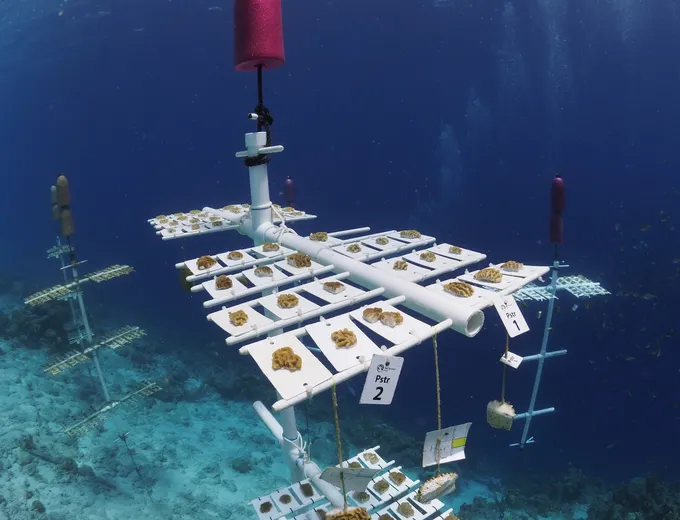
© Reef Renewal Foundation Bonaire
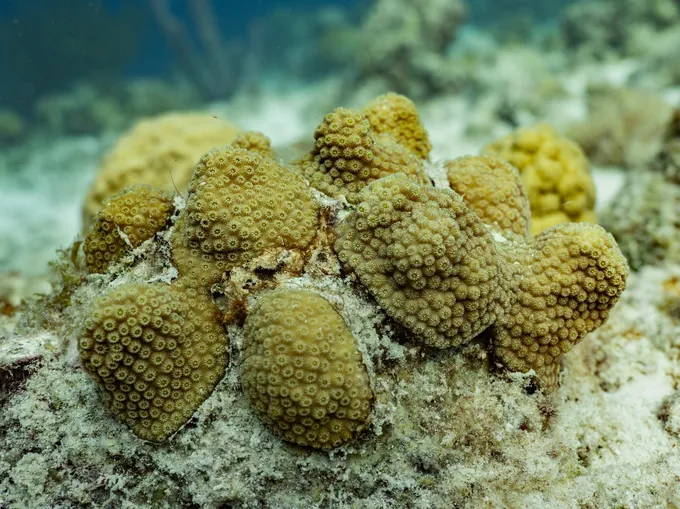
© Reef Renewal Foundation Bonaire
5. Increasing coral reef capacity and genetic diversity in Bonaire
Once home to some of the world’s healthiest coral reefs, Bonaire’s reefs have suffered severe degradation in recent years. Rising sea surface temperatures and coral disease outbreaks have taken a heavy toll on these vital Caribbean ecosystems.
In collaboration with Reef Renewal Foundation Bonaire, a new project will expand the island’s underwater coral nursery network, focusing on restoring four foundational reef‑building species—lobed star coral, symmetrical brain coral, mountainous star coral, and great star coral. Sixteen nursery units will be installed across four strategic locations along Bonaire’s coast.
Together, these nurseries will cultivate a genetically diverse, heat-tolerant broodstock (group of mature individuals) capable of supplying healthy coral to Bonaire’s reefs for years to come, helping safeguard the future of these extraordinary marine ecosystems.

© WWF-Laos
6. Community-led conservation of softshell turtles in Laos
The Asian giant softshell turtle—one of the world's rarest freshwater turtles—and the Asiatic softshell turtle are found in only a few remaining places, one of which is a stretch of the Mekong River in southern Laos. Rising sand and air temperatures, heatwaves, and increasingly erratic river flows are overheating nests, reducing hatching success, and skewing sex ratios through temperature-dependent sex determination. For species with already critically small or vulnerable populations, these pressures pose a serious threat to their survival.
To protect the species during the breeding season, we are launching a community-led conservation effort. Community-run hatcheries will be established in two villages, supported by locally trained Turtle Conservation Teams. These teams will locate nests, carefully relocate eggs from exposed sandbars, and monitor incubation conditions through hatching to improve survival rates. The project also invests in the next generation of conservation stewards. Through school outreach, a youth‑led “Turtle Guardian Team,” World Turtle Day campaigns, and ceremonial release events, the program aims to foster pride, connection, and long‑term commitment to turtle conservation within local communities.
Together, these interventions aim to increase hatchling survival, reduce climate-driven impacts, and establish a community-led model for protecting some of the Mekong's most endangered species.
Looking ahead…
At its core, the Wildlife Adaptation Innovation Fund is driven by impact. Looking into the future, we are focused on building resilience across more landscapes and for more species by funding new innovative ideas, scaling successful projects, and replicating them in new landscapes. Increasingly, this work is being woven into larger, landscape‑level initiatives that connect habitats, wildlife, and communities facing shared climate pressures, unlocking more holistic and lasting outcomes. At the same time, we recognize that innovation alone is not enough. Sustained investment in long‑term monitoring is essential to track what works, adapt when conditions change, and ensure these solutions remain effective.
Through commitment to learning and adaptation, we aim to help wildlife and people not just survive but endure in a rapidly changing world.
To stay up to date on these projects and other climate resilience work, sign up to receive a quarterly newsletter.
How you can help
© Chris Schmid
Pledge to protect nature
Do your part to protect what you love in your daily life. Nature needs us all more than ever.