Nature at the center: What to expect at Climate Week NYC and UNGA in 2026

© Yuriy T/iStockphoto/Getty Images
Later this month, Climate Week NYC returns to New York alongside the high-level week of the UN General Assembly (UNGA) running from September 20 to 27. Last year was the largest Climate Week NYC ever, drawing more than 100,000 attendees across 1,000 events, and this year has been announced as the biggest one yet.
While Climate Week NYC covers every dimension of the climate challenge—from energy and transport to industry, buildings, finance, and beyond—WWF will bring a strong nature focus to our UNGA and Climate Week NYC engagements. Climate change cannot be solved without the help of nature, and nature cannot thrive unless we address climate change. Elevating nature within the climate conversations that swell during Climate Week NYC and UNGA is essential to building a cleaner, more resilient, and just future.
What follows is a preview of the week through a nature lens: what I'll be watching for, what has shifted since last year, and what WWF is doing to help shape the week.
The stakes
The past 11 years have been the 11 warmest years on record since record-keeping began 176 years ago, and 2024 was the hottest year ever recorded globally.i In 2025, ocean heat content reached another record high, with roughly 90% of the world’s oceans experiencing at least one marine heatwave.ii
These impacts can feel abstract until you look at what they cost. Natural catastrophes caused $220 billion in global economic damages in 2025.iii The January wildfires in Los Angeles cost $40 billion in insured losses, the largest wildfire loss on record.iv About half of the global losses from exposure to natural hazards are uninsured, and in many emerging economies, where exposure is highest, 80% to 90% of catastrophe losses have no insurance coverage at all.v
Nature is among the most cost-effective protection we have against these rising climate impacts. Mangroves in front of coastlines, restored floodplains upstream of cities, forests that hold soil and regulate water, and other nature-based solutions are some of the best adaptation tools available, and we actually save money by investing in them. Every dollar spent on adaptation and resilience can yield up to ten dollars in benefits and avoided costs when a disaster strikes.vi
In spite of this, nature-based solutions are among the least funded. The world needs around $570 billion of annual investment to meet global climate, biodiversity and land conservation goals, but current investment is running at under 40% of that.vii Closing the gap between what we know works and what is being funded is what putting nature at the center of this week is about. It's the argument WWF has spent years building the case for.

© Shutterstock
What's shifted since last year
Despite today’s headwinds, a lot of climate and nature progress has continued over the past year, with a lot of it happening outside of formal negotiating rooms.
Conserving nature where it counts the most got a big boost from the creation of The Tropical Forest Forever Facility. At COP30 in Brazil last November, the facility launched with $6.7 billion in initial commitments.viii It has since started building the machinery that makes a fund real: The World Bank is the trustee and interim host of its secretariat, and an interim board is now co-chaired by Brazil and Norway. This momentum is set to continue as more announcements are expected by the end of the year.
The high seas also got a rulebook. The High Seas Treaty crossed its 60-ratification threshold during last year's UNGA week and entered into force on January 17.ix For the first time, there is a legally binding framework for protecting biodiversity in the roughly two-thirds of the ocean that lies beyond any national jurisdiction, including a route to establishing high seas marine protected areas.
And private capital started showing up. More than $60 billion of private investment has flowed into nature over the past decade, with annual flows now roughly five times higher than in 2016 and more than $14 billion last year alone.x Against what's needed, that is still small. But investors now have a growing track record of projects and performance to build on.
Where to find WWF
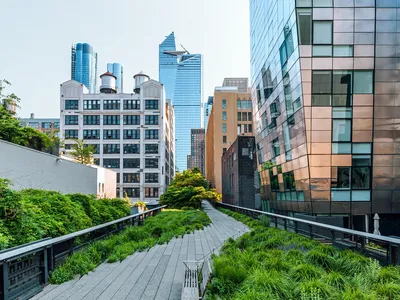
WWF’s Panda pawprints will be found across New York City this year. We will be convening discussions on aligning insurance markets with climate resilience at Fordham Law School, joining a Shark Tank-style pitch session connecting nature-based solutions with funders, and bringing together leading companies for our Annual Climate Business Roundtable. The focus of that conversation is helping businesses move beyond setting goals and into the more challenging work of integrating climate and nature considerations into business strategy.
The anchor for all WWF's participation will be Panda House, a full day of sessions designed to turn commitments into conservation.
There, we will hear from senior government leaders on how adaptation commitments can be integrated into national planning, budgets, and investment decisions—the gap where most nature-based adaptation stalls. With the Paulson Institute and The Nature Conservancy, we will release Financing Nature: The Future of Biodiversity Finance, the latest in a report series that has sized the global biodiversity finance gap, shifting the conversation from diagnosing that gap to scaling the solutions that can close it. And with the Science Based Targets Network and the Lincoln Institute of Land Policy, we will unveil the Freshwater Basin Threshold Tool, giving companies a science-based way to turn water commitments into action across their supply chains.
The full calendar of WWF events during Climate Week NYC and UNGA, including additional Panda House sessions on ocean conservation and country-level adaptation and resilience, can be found here.
© Alexandr Spatari / Moment RF / Getty Images
Find WWF at Climate Week NYC
See our calendar of events in New York City and register to join WWF and leading climate experts as we turn climate commitments into action.
Register nowBeyond this week

© Toshi Sasaki / Photographer's Choice RF / Getty Images
Climate Week and UNGA are a key waypoint on the climate calendar in part because they signal how much progress to expect at the formal UN climate negotiations each November.
The pattern that has emerged in recent years is that progress is not limited to the formal UNFCCC process but is increasingly happening in the coalitions, side rooms, and regional gatherings happening throughout the year. This is why convening leaders at Panda House and across New York City matters. These are the spaces where coalitions form, solutions are refined, and momentum for nature is built between the official plenaries and negotiations.
I will be back with a recap of what was accomplished during the week and where we see momentum as we head toward COP31 this November. In the meantime, I hope you'll explore the full suite of events WWF is helping shape at Panda House and across New York City.
We would love to see you there.
Endnotes
i WMO (2026). WMO confirms 2025 was one of warmest years on record. Press release, 14 January 2026. Geneva: World Meteorological Organization. Available at: https://wmo.int/news/media-centre/wmo-confirms-2025-was-one-of-warmest-years-record
ii AMS (2026). International "State of the Climate" report confirms record-high greenhouse gases, global sea level, and ocean heat in 2025. News release, 10 August 2026. Boston: American Meteorological Society. Available at: https://www.ametsoc.org/ams/about-ams/news/news-releases/international-state-of-the-climate-report-confirms-record-high-greenhouse-gases-global-sea-level-and-ocean-heat-in-2025/
iii Munich Re (2026). Climate change presses on: devastating wildfires and intense thunderstorms exacerbate losses for insurers — natural disaster figures for 2025. Media release, 13 January 2026. Munich: Münchener Rückversicherungs-Gesellschaft. Available at: https://www.munichre.com/en/company/media-relations/media-information-and-corporate-news/media-information/2026/natural-disaster-figures-2025.html
iv UNDRR (2026). The invisible costs of wildfire disasters in 2025. News article, 13 January 2026. Geneva: United Nations Office for Disaster Risk Reduction. Available at: https://www.undrr.org/news/invisible-costs-wildfire-disasters-2025
v Swiss Re Institute (2026). Adaptation and insurance: strategies to narrow the protection gap. Chapter 4 in sigma 1/2026: Natural catastrophes in 2025 — the persistent rise of wildfire and storm risk. Zurich: Swiss Re Institute. Available at: https://www.swissre.com/institute/research/sigma-research/sigma-2026-01-natcat-2025-wildfire-storm-risk/adaptation-insurance-narrow-protection-gap.html
vi WRI (2025). WRI study finds climate adaptation investments yield massive returns — over $10 for every $1 spent. Press release, 3 June 2025. Washington, DC: World Resources Institute. Available at: https://www.wri.org/news/release-wri-study-finds-climate-adaptation-investments-yield-massive-returns
vii UNEP (2026). State of Finance for Nature 2026: nature in the red — powering the trillion dollar nature transition economy. Nairobi: United Nations Environment Programme. Available at: https://www.unep.org/resources/state-finance-nature-2026
viii TFFF (2025). COP30 ends with over US$6.7 billion for the TFFF. Press release, 27 November 2025. Tropical Forest Forever Facility. Available at: https://tfff.earth/cop30-ends-with-over-us-6-7-billion-for-the-tfff/
ix Mishra, V. (2025). 'UN "high seas" treaty clears ratification threshold, to enter into force in January', UN News, 20 September 2025. Available at: https://news.un.org/en/story/2025/09/1165901
x TNC and Forest Trends (2026). Gaining ground: state of private investment in nature, 2026. Arlington, VA: The Nature Conservancy and Forest Trends. Available at: https://www.nature.org/en-us/what-we-do/our-insights/perspectives/gaining-ground-state-of-private-investment-in-nature-2026/