Climate change and the Eastern Himalayas
Rapid changes in a global biodiversity hotspot
© Neyret & Benastar / WWF
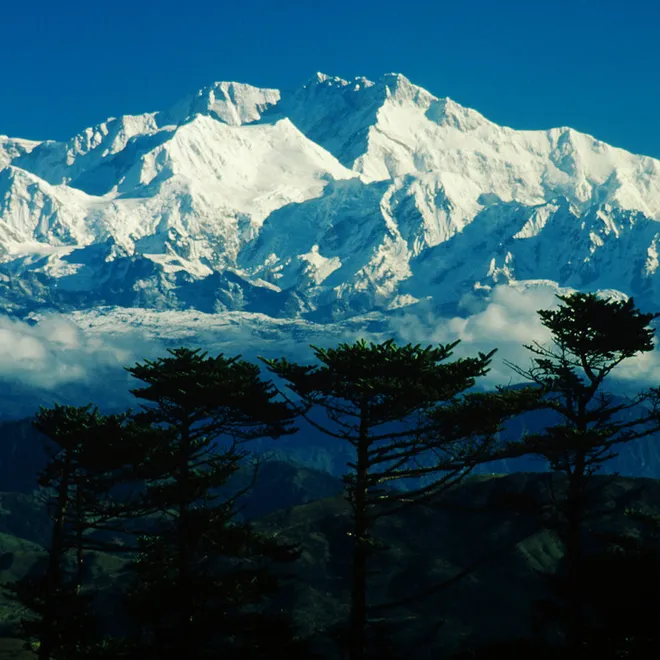
The Eastern Himalayas stretch more than 1,500 miles across Nepal, Bhutan, and northeastern India and rank among the world's most important biodiversity hotspots, where iconic species such as snow leopards, red pandas, and one-horned rhinoceroses can be found roaming ecosystems from riverine mangroves to alpine tundra. The greater Himalayan range, often referred to as the "Third Pole," also holds one of the world's largest stores of frozen freshwater outside the Arctic and Antarctica.
This vast mountain system plays a critical role in regulating the climate and water cycle of South Asia, acting as a barrier that prevents dry northern air from disrupting the monsoon systems that sustain the region.1 At the foot of the mountains, the Ganges and Brahmaputra rivers provide freshwater to roughly one billion people, underscoring the Eastern Himalayas' importance not only as a global biodiversity hotspot but also as a vital source of water security and climate stability for much of Asia.
Mounting climate risks
Climate change is rapidly emerging as one of the greatest threats to the Eastern Himalayas, as rising temperatures are accelerating glacial melt, increasing the risk of flooding, riverbank erosion, and damage to homes, infrastructure, and livelihoods downstream.2 Warming temperatures are also intensifying monsoon rainfall, contributing to more frequent and destructive floods and landslides that threaten both human settlements and fragile mountain ecosystems.1
These growing climate risks are unfolding alongside widespread habitat loss, degradation, and fragmentation driven by human activities, as well as persistent poaching and illegal wildlife trafficking that continue to endanger vulnerable species. As temperatures climb, wildlife are being forced to move to higher elevations in search of suitable habitat. This shift is increasing competition among species, while animals unable to adapt or migrate face heightened risks of population decline and extinction.3

© Dong Lei / www.naturepl.com
Climbing toward a more sustainable future

© Sascha Fonseca / WWF-UK
Conservation efforts across the Eastern Himalayas are gaining momentum as governments, local communities, and international organizations work to address escalating climate and biodiversity threats. In Nepal, WWF and its partners are advancing the Freshwater Challenge, a global initiative focused on restoring degraded rivers and wetlands by 2030 to strengthen ecosystem resilience and water security.
While the region faces mounting pressures from climate change and human activity, these ambitious conservation efforts offer a pathway to protect critical freshwater resources, conserve globally important biodiversity, and strengthen the resilience of the hundreds of millions of people who depend on the Eastern Himalayas.
References
1 UCAR. (n.d.). Monsoons. UCAR Center for Science Education. Retrieved July 22, 2026
2 Jacob, S. (2023). Climate variations of Himalayas based on different whether conditions. Global Journal of Geosciences and Geoinformatics, 1–2.
3 Girish, K. S., & Srinivasan, U. (2022). Community science data provide evidence for upward elevational range shifts by Eastern Himalayan birds. Biotropica, 54(6), 1457–1465.