Publications
-
WWF‚'s Network-wide Ivory Initiative came to an end in June 2022, after more than four years of successful work, focused on demand reduction and policy advocacy to shut down Asia‚'s elephant ivory markets. The initiative was built on the game-changing decision by China in 2017 to shutter its domestic market for elephant ivory. WWF-US was one of the key architects, part of a collective drive alongside NGOs, governments, businesses, and other partners.
The Elephant Ivory Initiative Report: 2018-2022 is an independent assessment that highlights the legacy, achievements, and lessons learned.
-
As efforts to address the global plastic waste and pollution crisis increase, there is a growing focus on reuse as a solution. Reuse systems can provide a number of potential benefits over conventional linear approaches, but it is important to ensure that these systems are built on a solid set of principles. This position paper seeks to lay out a framework through which reuse systems can support WWF's vision of No Plastic in Nature.
This position paper was updated in January 2024 to include recommendations on return and refill modalities.
-
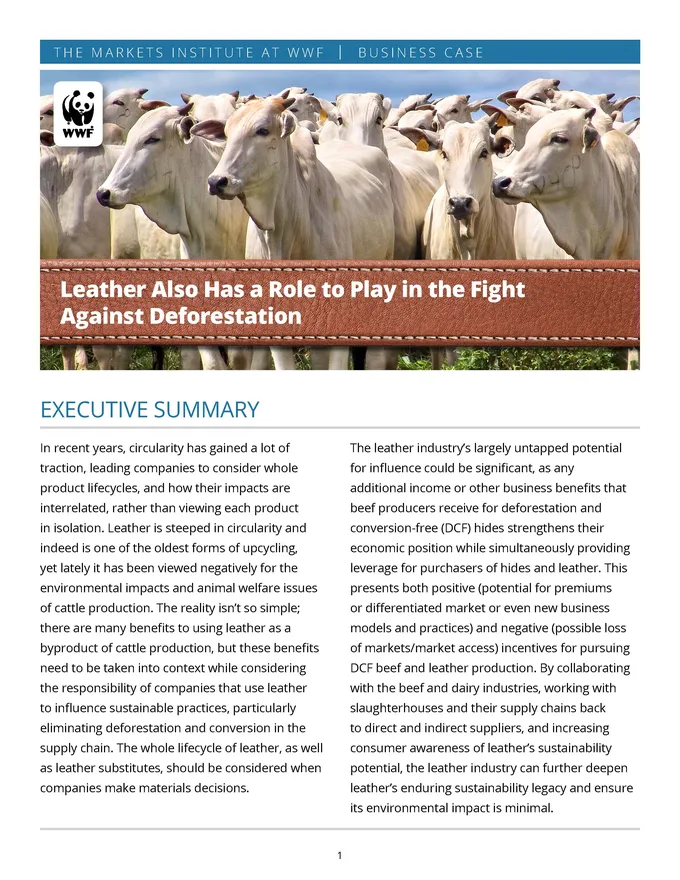
All buyers of cowhides or leather anywhere along the value chain ‚Äì from slaughterhouses to consumers ‚Äì have a role to play in driving more sustainable production and eliminating deforestation and conversion. Given leather‚'s status as a luxury good and association with quality, consumer pressure for and awareness of sustainable practices is high. Thus, leather companies and their customers hold a unique lever that can be used to encourage and support sustainable practices.
-
The report Crimes that Affect the Environment and Climate Change explores the relationship between environmental crime, biodiversity loss, and climate change. Co-authored by the UN Office on Drugs and Crime and WWF, the report explores illegal activity in marine and forest ecosystems and trafficking in waste to understand their impact on the environment.
The legal and judicial systems offer potential solutions to these problems that are under-utilized. The report offers potential paths forward for legal and judicial reform that emphasize the importance of measuring generational harm when calculating the impact of climate change on human well-being.
-
Learn about the Arctic Program's vision for healthy Arctic ecosystems that support the cultural, social, and economic needs of the people living there, and that protect the diversity of Arctic life.
-
Learn how WWF-US is engaging financial markets and deploying capital to strengthen the environmental, social, and economic resilience of the blue economy.
-
Learn how WWF-US is working with industry to drive net-positive impacts on biodiversity, people, and climate.
-
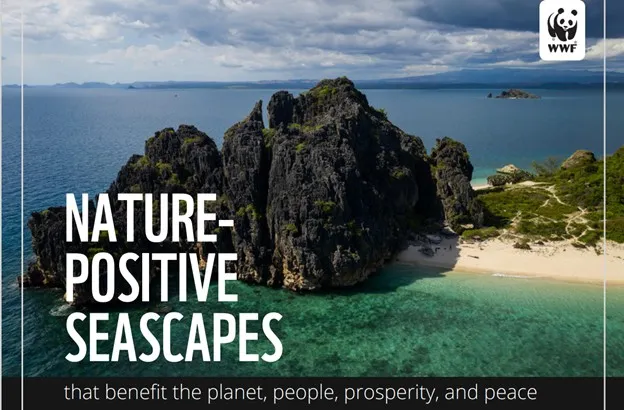
Learn how WWF-US is working with partners to co-create nature-positive seascape solutions that drive climate adaptation and resilience, food and livelihood security, peace and security, and healthy oceans outcomes in the Arctic, Latin America, Southern Africa, Southeast Asia, and the South Pacific.
-
Learn how WWF-US is developing innovative programs at the intersection of climate change, ocean health, and peace and security.
-
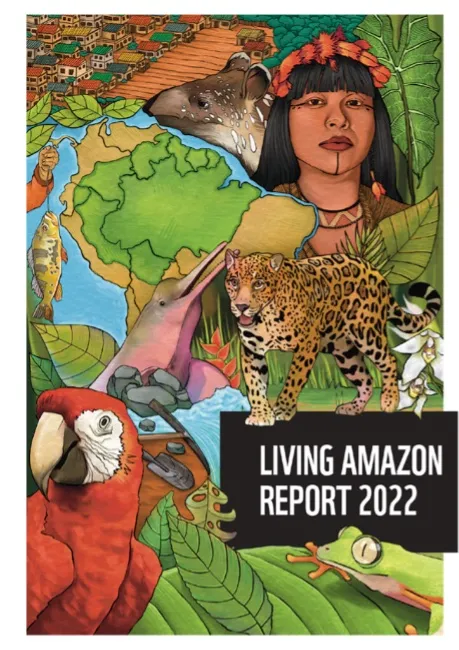
The Living Amazon Report 2022 focuses on the urgency of formulating and implementing action plans based on resilience in the face of global change, The report collects successful experiences implemented by WWF and partners throughout the biome that can be replicated and scaled. A different future is possible for the Amazon, if we collectively act now.