Meet the babirusa, a wild pig with massive teeth
The tusks of the male babirusa can be deadly—to itself. This wild pig’s upper canine teeth curve back toward its forehead as they grow continuously throughout its life, reaching up to over a foot long. If they grow long enough, the tusks can even pierce the animal’s skull. But luckily for the babirusa, whose name means “pig-deer” in Malay, that’s a rare occurrence, as their tusks are fragile and can break easily.

© DIDIER DESCOUENS
© DOUGLAS - STOCK.ADOBE.COM
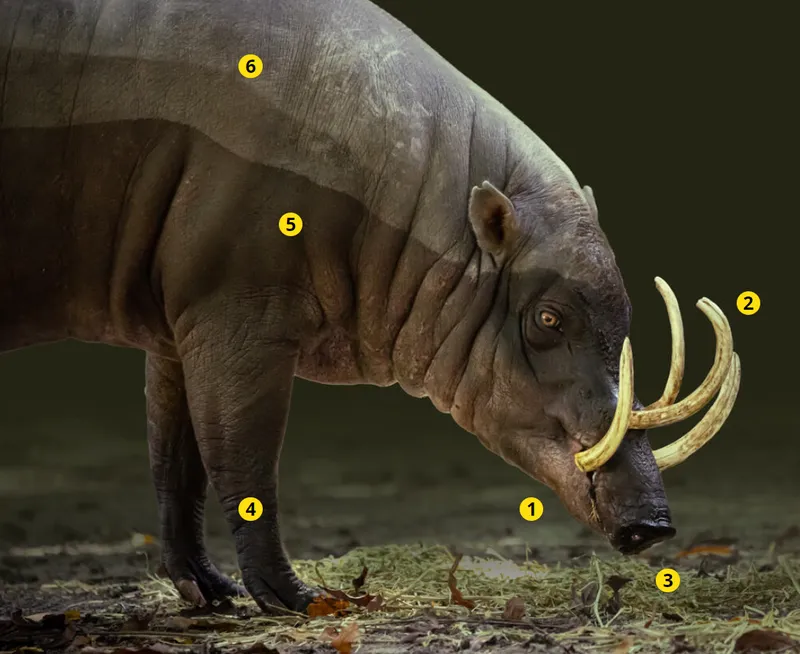
NORTH SULAWESI BABIRUSA
Babyrousa celebensis
RANGE | The Indonesian islands of Sulawesi, Togian, Sula, and Buru
HABITAT | Rain forest and wetlands
SIZE | About 2' tall and 3' long
WEIGHT | Up to 220 lb.
DIET | Fruit, plants, and small animals
THREATS | It’s estimated that there are just 10,000 babirusas in the wild due to hunting and habitat loss
1. LOWER CANINE TUSKS Possessed by both sexes
2. UPPER CANINE TUSKS As with deer antlers, grow only on males; thought to potentially attract females
3. SNOUT Lacks a thick rostral bone, unlike other members of the pig family, making it too weak to root into hard ground
4. LEGS Long and slender, with hooves that help dig for food and walk, run, and swim in tropical or swampy forest habitats
5. STOMACH Two-chambered, more closely resembling those of sheep and cows than pigs, from which they diverged between 10 and 19 million years ago
6. BODY Stocky and round with gray or brownish skin
READY TO RUMBLE?
When male babirusas fight, they stand on their hind legs and “box” with their front legs—a behavior that means their tusks may be unrelated to combat or self-defense.

© A & J VISAGE/ALAMY STOCK PHOTO
TOP SPEED
Babirusas are among the fastest runners in the pig family, able to reach 30 miles per hour.
ANCIENT OINKERS
Sometimes called “prehistoric pigs,” babirusas appear in cave drawings from 35,000 years ago.

© TOM COATES
Explore more
Keep reading this issue of World Wildlife magazine