Camera traps showcase Malaysia’s incredible biodiversity
A glimpse into a forest with tigers, clouded leopards, and sun bears

© Emmanuel Rondeau / WWF
As the sun begins to dip below the horizon of Malaysia’s Royal Belum State Park, the team makes the final adjustments to the last of eight digital camera traps. Everyone is in good spirits, and the leeches have taken a day off as the ground is dry underfoot.
The light may be fading, but the anticipation is high.
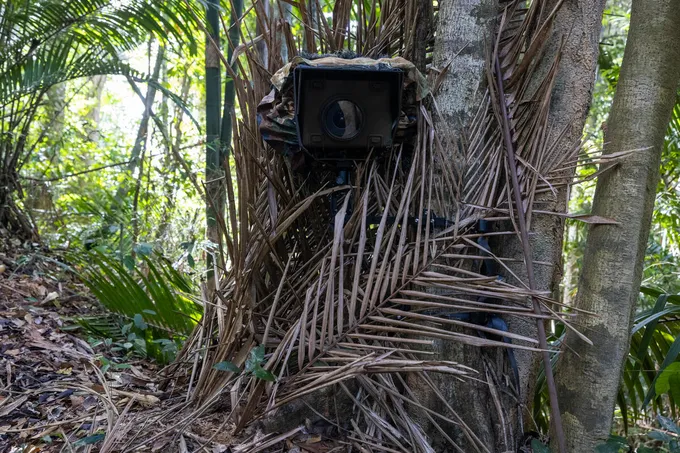
An anti-poaching team of dedicated Indigenous peoples working with WWF-Malaysia has trekked for a week through these dense, humid forests of wildlife with photographer Emmanuel Rondeau to set up a series of high-quality cameras in this 130-million-year-old rainforest.
© Emmanuel Rondeau / WWF
© Emmanuel Rondeau / WWF
The motion-sensor camera system, designed by Emmanuel, is installed across this forest for the next five months, waiting to capture wildlife walking by and triggering the camera to take a photo.
Across Southeast Asia, tiger populations are decreasing. In Cambodia, Lao PDR, and Viet Nam they’re already nationally extinct. Malaysia’s tiger population is at an all-time low—fewer than 150 tigers are left in the country. What’s driving tigers, their prey, and other wildlife towards extinction in this region? Snares.
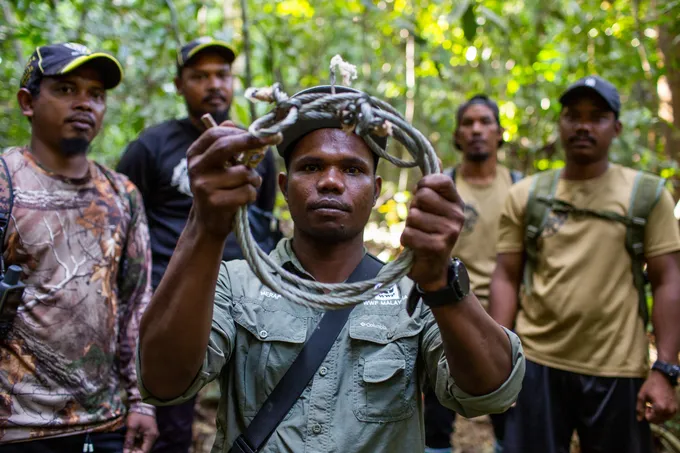
Deadly traps made from wire, snares are set by poachers in the hope of catching wildlife, and prized most of all is the tiger. Snares have significantly contributed to Malaysia’s decline in tiger populations.
What the camera traps found
Months after their initial setup, the camera traps revealed the rich diversity of wildlife in one of the world’s oldest forests and what’s at stake if poaching, deforestation, and human-wildlife conflict are not addressed.

© Emmanuel Rondeau / WWF
Tiger
Royal Belum State Park is one of the country’s last strongholds of tigers. Increasing tiger populations in Malaysia is by no means impossible and would be a historic achievement. But it requires political will, sustainable financing, and support from Indigenous Peoples and local communities.

© Emmanuel Rondeau / WWF
Black leopard
The Malay Peninsula is home to the world’s largest population of black leopards (also known as black panthers). Black leopards get their colour from a genetic mutation that causes an overproduction of the dark pigment melanin, which results in black fur coats and is very hard to see against the backdrop of the rainforest.

© Emmanuel Rondeau / WWF
Malay tapir
The Malay tapir is one of many unique animals that live in this rainforest. With its long snout and patchwork markings, it is the only species of tapir that can be found in Asia. Listed by the IUCN as endangered, they spend most of their time wandering the rainforest looking for shoots and leaves to eat.

© Emmanuel Rondeau / WWF
Clouded leopard
Although known as one of the most arboreal (tree-dwelling) cat species, the clouded leopard spends ample time on the forest floor. Little is known about this elusive cat, but it preys on primates, rodents, small deer, and wild boars, which it ambushes from the trees or stalk from the ground.

© Emmanuel Rondeau / WWF
Sun bear
A sun bear, also highly sought after by poachers, scales twisted vines and roots in its search for fruits, small rodents, birds, termites, and other insects to eat. These bears are endemic to Southeast Asia and are the smallest of the bear family.

© Emmanuel Rondeau / WWF
The hard work of park patrols
Thanks to a dedicated anti-poaching patrol, conservation efforts have ramped up in recent years in an effort to halt the decline of tiger populations. In Royal Belum State Park today, there are 60 patrol team members, made up of Indigenous Peoples from communities in the area. They have already proved essential in reducing active snares by 98% inside the park.
The teams plan patrol routes ahead of schedule and send out a team of roughly 10 anti-poaching members for one or two weeks at a time. Navigating by GPS devices, they scale the forests for signs of poachers and snares and, more recently, set hundreds of camera traps to monitor the status of wildlife and threats in the landscape.
We have the opportunity to ensure a future for tigers in Malaysia and every tiger country. Only urgent conservation on a large scale will reverse the national decline of tigers.
The time for action is now.