NEAT: Nature-based Solutions for Adaptation Evaluation and Advisory Toolkit
NbS-A project evaluation against five foundational criteria available in English, Spanish, and French
NEAT is a collection of resources designed to use artificial intelligence to assess and provide guidance for projects that use biodiversity and ecosystem services to help people adapt to climate change.
© WWF-US/Mac Stone
What is NEAT?
Wondering whether your project qualifies as NbS-A, also known as Ecosystem-based Adaptation (EbA)? Or want to strengthen a concept for funding? NEAT can help.
NEAT is an AI-assisted toolkit built around two documents: A guide you upload to your AI assistant and a set of prompts you paste into the chat. It finds gaps in your project or concept and suggests how to strengthen it. It's built for anyone developing or supporting an NbS-A or EbA project, including conservation, development, and humanitarian organizations, government agencies, consultants, and donors.
NEAT evaluates submissions against five foundational criteria, identifying ways to strengthen concepts, proposals or existing projects. It starts with people: who is vulnerable, and to which climate hazards? Then it asks which ecosystem services reduce that risk, what actions will secure them, and how biodiversity benefits alongside the people it protects. A project must meet all five to qualify.
Who NEAT is for
NEAT is especially useful for practitioners who are designing projects that need adaptation funding but are unsure whether their concept meets accepted NbS-A/EbA principles.
- Conservation and environmental NGOs
- Development organizations
- Humanitarian organizations
- Government agencies
- Project consultants
- Donors and funding agencies

© Tom Vierus / WWF-UK
How to use NEAT
Before you start, you'll need your project document, the NEAT AI-Assisted Guide and Prompts documents, and a generative AI assistant.
Steps
- Upload the Guide. Open your AI assistant, click the attach or upload icon, and upload the NEAT AI-Assisted Guide PDF.
- Upload your project document. It can be an early idea, a concept note, or a full proposal. The more detail, the more useful the feedback. Check your organization's policy and your AI provider's data policy before uploading unpublished material.
- Paste the Primary Prompt. From the Prompts document, copy the Primary Prompt exactly as written and paste it into the chat.
3b (optional). Add optional prompts. Optional prompts, found directly under the Primary Prompt in the Prompts document, tailor the feedback to your project's stage or your NbS-A experience. Paste any that apply below the Primary Prompt in the chat. - Send and wait. Press enter. A full assessment arrives within a few minutes.
- Read your assessment. It opens with whether your project qualifies as NbS-A/EbA, then rates each of the five criteria as Met, Partially Met, Not Evident, or Not Met, citing evidence from your document. It closes with strengths, gaps, five questions a reviewer is likely to ask, and recommendations.
- Revise and run it again. The assessment is AI-generated, so review it before you act on it. You may just need to explain your project better, or you may need more technical work or a redesign. Revise and rerun as often as you like.
How to access NEAT
NEAT is available in English, French, and Spanish. To request the toolkit documents, or if you have questions, please email [email protected].

© Karine Aigner/WWF-US
© Tuane Fernandes / WWF-Brazil
Why NEAT
Conservation, development, and humanitarian organizations are increasingly interested in projects that use nature's services to help people adapt to climate change. These projects can be relatively low cost while also delivering biodiversity and social co-benefits.
Yet many projects do not follow established adaptation principles or align with donor expectations. Often a project delivers valuable conservation or development outcomes but does not qualify as a Nature-based Solution for Adaptation, also called Ecosystem-based Adaptation (EbA), because critical design elements are missing.
Common challenges include:
- Confusion about the terms NbS, NbS-A, and EbA
- Limited understanding of adaptation principles
- Weak links between climate risks and proposed interventions
- Insufficient attention to biodiversity
- Unclear beneficiaries
- Projects labeled as NbS-A or EbA that do not meet qualifying criteria
What NEAT can and cannot do
Strong adaptation projects are built through engagement with affected communities, scientific analysis, and careful planning. NEAT supports those processes rather than replacing them.

NEAT can help you:
- Assess whether a project qualifies as NbS-A/EbA
- Identify strengths in project design
- Identify weaknesses or missing elements
- Suggest areas to improve concepts before you submit them
- Anticipate potential questions from project reviewers
- Learn the principles and terminology of adaptation and ecosystem-based approaches

NEAT cannot:
- Conduct stakeholder consultations
- Perform vulnerability assessments
- Identify project beneficiaries
- Replace technical experts
- Design projects on your behalf
- Tailor recommendations for specific donors or guarantee donor funding
The five criteria NEAT checks
NEAT checks your project against five foundational criteria. A project qualifies as NbS-A/EbA only when all five are satisfied.
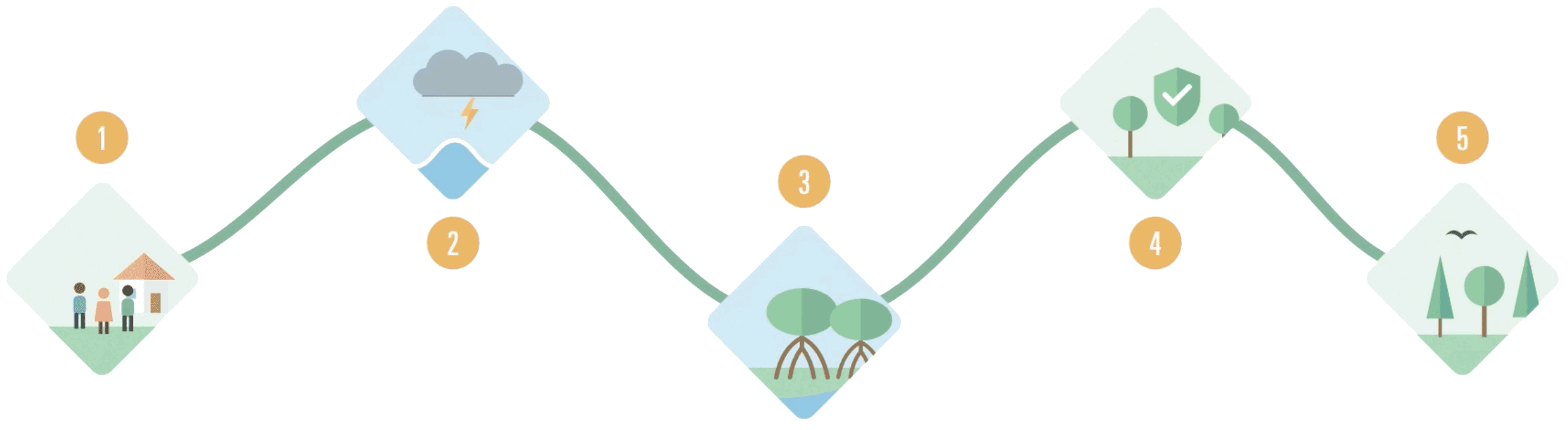
- It starts with people: Who is vulnerable?
- To which climate hazards?
- Which ecosystem services reduce that risk?
- What actions will secure them?
- How does biodiversity benefit alongside people?
What's in the toolkit
The NEAT AI-Assisted Guide
A reference document in three parts that you upload to your AI assistant.
- Part I: What NEAT does and does not do, the five foundational criteria, the climate hazards used throughout, and the twelve categories a project can fall into
- Part II: Core concepts and terminology, including NbS, NbS-A and EbA; adaptation and resilience; hazards and impacts; vulnerability and risk; and ecosystem services and biodiversity
- Part III: The instruction set the AI follows when it assesses your project (you do not need to read it)
The NEAT AI-Assisted Prompts
A short document you copy from and paste into the chat. It contains:
- The Primary Prompt, which runs the full assessment on its own
- Optional add-ons for your experience level and your project's stage
Frequently asked questions
What is the difference between NbS, NbS-A, and EbA?
Nature-based Solutions (NbS) is an umbrella term covering any nature-based response to a societal challenge, including climate change mitigation and disaster risk reduction. NbS-A applies nature-based solutions specifically to helping people adapt to climate change. EbA is the older, established term and means the same thing in practice. NEAT treats NbS-A and EbA as equivalent.
What is the difference between the Guide and the Prompts document?
You upload the Guide to your AI assistant alongside your project document. You copy the Primary Prompt from the Prompts document and paste it into the chat. The Prompts document itself is not uploaded.
Which AI assistant do I need? Does it have to be paid?
Claude, ChatGPT, Gemini, and Copilot all work. Paid versions tend to perform better, but free versions work fine. Free versions may limit how many files you can upload or which file types they accept, so keep your project document as a Word file or PDF.
Do I have to use all the prompts?
No. Only the Primary Prompt is required; it runs the full assessment on its own. The optional add-ons change how the assistant explains things, not how strictly it judges your project.
I am new to adaptation. Can I still use it?
Yes. Add the "New to this" prompt below the Primary Prompt. It keeps the language simple and explains technical terms as they come up.
Can I use it on an early idea, or does it need to be a full proposal?
Any stage works. Use the project stage add-ons so the assessment matches how much detail you have. Early concepts are marked "Not Evident" where information is missing, rather than penalized for it. You can revise and run it again as often as you like.
My project does not qualify as NbS-A. Is it a bad project?
No. The assessment answers one narrow question: does your project meet the established criteria for NbS-A/EbA? Strong conservation, development, and disaster risk reduction projects routinely do not qualify, because they were built to do something else. The assessment names the category that best matches your project based on the information provided.
My project qualified. Does that mean it will get funded?
No. Qualifying means all five criteria are satisfied. It does not mean the project meets a funder's specific requirements. Qualifying projects can still have gaps, and the assessment identifies them.
I ran the same project through two different AI assistants and got different results. Why?
Think of asking two experts for their advice on the same thing. You may get different answers. Models weigh ambiguous evidence differently, so a project sitting near a category boundary can land on either side. A large divergence usually points to a genuine gap in the document rather than a flaw in the model. Read both assessments and look at where the evidence was thinnest.
Disclaimer
AI-generated content may contain errors, omissions, or biases. NEAT does not constitute legal, financial, or professional advice whatsoever. By using NEAT, users acknowledge and accept the risks associated with AI-generated content, including potential inaccuracies, and agree that WWF shall not be held liable for any loss, damage, or consequence arising from using NEAT. Users retain full responsibility for the final assessment and its use.
NEAT supports project design. It does not replace stakeholder engagement, vulnerability assessments, or a funder's own review, and it cannot guarantee funding. Documents you upload go to the AI provider you choose, not to WWF. We do not see, receive, or store anything you upload. Check your provider's data policy before uploading unpublished or sensitive material.