Publications
-
This 2010 WWF report provides an overview and analysis of the state of natural resources in Sumatra and its eight mainland provinces. It includes data and information about the loss of natural forests from 1985 to 2009, loss of carbon stock in natural forests and peat, deforestation and eco-floristic diversity, as well as deforestation and mega-fauna diversity. The report also includes suggestions for prioritizing conservation and restoration interventions in Sumatra.
-
Through the Salmon Aquaculture Dialogue (SAD), performance-based standards for salmon farming are being developed. This document provides the first draft of the principles and criteria that will form the final standards. When completed, the final standards will help minimize the key environmental and social impacts related to salmon farming.
-
Through the Freshwater Trout Aquaculture Dialogue (SAD), performance-based standards for freshwater trout farming are being developed. This document provides the first draft of the principles and criteria that will form the final standards. When completed, the final standards will help minimize the key environmental and social impacts related to freshwater trout farming.
-
Addressing global water challenges is of critical importance to both World Wildlife Fund and The Coca-Cola Company. This report highlights the results of our transformative partnership to conserve freshwater resources around the world achieve in 2009.
-
Through the Shrimp Aquaculture Dialogue (ShAD), performance-based standards for shrimp farming are being developed. This document provides the first draft of the principles and criteria that will form the final standards. When completed, the final standards will help minimize the key environmental and social impacts related to shrimp farming.
-
Analysis by WWF of palm oil production in Kalimantan, Indonesia, found that by pursuing a strategy of yield intensification and planting on degraded lands, the palm oil industry would effectively be able to tackle financial hurdles, minimize impact on biodiversity, and meet climate change criteria in terms of carbon payback without further deforestation.
-
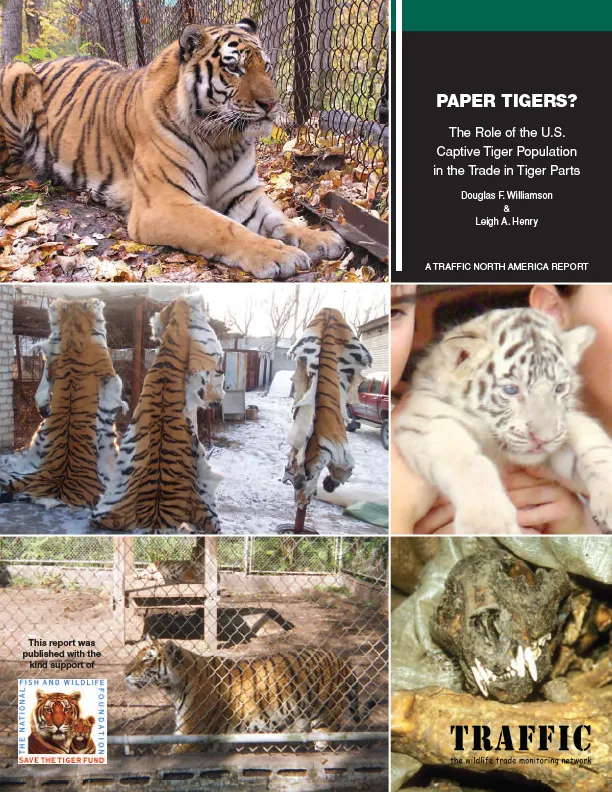
The emergence of a large captive tiger population in China is a recent phenomenon, resulting from efforts to develop a new, legal source of tiger parts to meet an enduring domestic demand for tiger parts in traditional Chinese medicine. The United States‚' captive Tiger population, by contrast, grew slowly over many years, not for purposes of trade or consumption, but rather because of demand for live cats for exhibitional use, and also to feed a market for people who desire these cats as "pets."
The ongoing decline of wild tiger populations, coupled with ongoing commercial demand for their parts, led TRAFFIC North America to question whether and how trade pressure might come to affect the U.S. captive tiger population. We speculated that persistent demand for tiger parts, combined with a potentially reduced supply from the wild, might lead those involved in the illegal tiger trade to target the U.S. captive tiger population. We looked at this issue with the end question always being whether and how this possible source of illegal parts might, in turn, impact tigers in the wild.
-
This document summarizes the findings and lessons from a review, undertaken by WWF, geared toward strengthening WWF‚'s partnerships with indigenous peoples and local communities.
-
For nearly a quarter century, Bristol Bay has been off limits to oil and gas development. But protection has been peeled away with the lifting of the Congressional moratorium in 2004 and Presidential Withdrawals in January, 2007.
-
Case studies of WWF’s work with indigenous peoples around the world.