Publications
-
Money is at the heart of environmental crimes that exploit wildlife, forests, fisheries or other natural resources. These transnational crimes generate significant profits, estimated at USD 7-23 billion annually for wildlife crime alone, and are mostly “serious, organized crime on an industrial scale driven by the profit motive”. Wildlife traffickers rely heavily on bribery of officials, including rangers, customs, agents, prosecutors, and judges, as well as complex fraud and tax evasion.
---
This content is made possible by the generous support of the American people through the United States Agency for International Development (USAID). The contents are the responsibility of World Wildlife Fund (WWF) and do not necessarily reflect the views of USAID, the United States Government, or individual TNRC consortium members.
-
The case study programs highlighted in this report in Nepal, Vietnam, and Uganda all indicate that meaningful citizen participation and multi-stakeholder collaboration can contribute to local and national NRM governance systems with the potential for sustainably reducing corruption.
---
This content is made possible by the generous support of the American people through the United States Agency for International Development (USAID). The contents are the responsibility of World Wildlife Fund (WWF) and do not necessarily reflect the views of USAID, the United States Government, or individual TNRC consortium members.
-
Equitable sharing of the benefits of conservation is essential to successful conservation efforts and sustainable use of natural resources. Effective benefit sharing, facilitated by transparent and informed decision-making, can help build community partnerships and support for conservation, facilitate law enforcement, and prevent conflicts and corruption. Recent changes in Kenya’s legal frameworks for managing wildlife and forests have reformed benefit sharing between state or private investors and local communities. Conservation interventions increasingly build on the opportunities provided by these institutional and legal reforms.
However, benefit sharing requirements have been weakened by gaps in implementation and gazettement of required regulations and guidelines. Coupled with weak enforcement of local accountability mechanisms, these gaps provide opportunities for corruption, including diversion of conservation funds for private use, systemic bribery, and rent seeking in wildlife and forestry contracts. A range of coordinated anti-corruption strategies must therefore be included when closing these institutional and regulatory gaps. Technological solutions may help. For example, integrated revenue systems could promote information transparency and accountability in revenue collection and use.
---
This content is made possible by the generous support of the American people through the United States Agency for International Development (USAID). The contents are the responsibility of World Wildlife Fund (WWF) and do not necessarily reflect the views of USAID, the United States Government, or individual TNRC consortium members.
-
Beneficial ownership transparency (BOT) aims to uncover the identity of “beneficial owners” who ultimately control assets. BOT allows law enforcement and the public to track bad actors’ connections to other businesses and hold them accountable for any corruption, illegal activities, or illicit fund transfers. For the natural resource management (NRM) sector, progress in BOT could play a significant role in deterring corruption, particularly corruption that can infiltrate resource supply chains.
Regulations around BOT are changing quickly, with dozens of countries enacting important rules to combat corruption and illicit money and trade in just the last few years. Even though many loopholes remain, it is important for NRM practitioners to understand the beneficial ownership rules at the sites where they are working and make use of BOT where possible to safeguard programs from natural resource crime and associated corruption.
---
This content is made possible by the generous support of the American people through the United States Agency for International Development (USAID). The contents are the responsibility of World Wildlife Fund (WWF) and do not necessarily reflect the views of USAID, the United States Government, or individual TNRC consortium members.
-
Complex corporate structures, while legal, and jurisdictions that allow or encourage the use of such mechanisms such as flags of convenience and financial secrecy jurisdictions, obscure the identity of beneficial owners in the fisheries sector. The lack of transparency, oversight, standardized rules, and enforcement around beneficial ownership facilitates corruption and complicates efforts to combat IUU fishing.
Large-scale reforms are needed to regulate the use of complex company structures, improve transparency of ultimate beneficial owners, and prevent the exploitation of opaque jurisdictions and flag states that facilitate illegal fishing and associated crimes.
---
This content is made possible by the generous support of the American people through the United States Agency for International Development (USAID). The contents are the responsibility of World Wildlife Fund (WWF) and do not necessarily reflect the views of USAID, the United States Government, or individual TNRC consortium members.
-
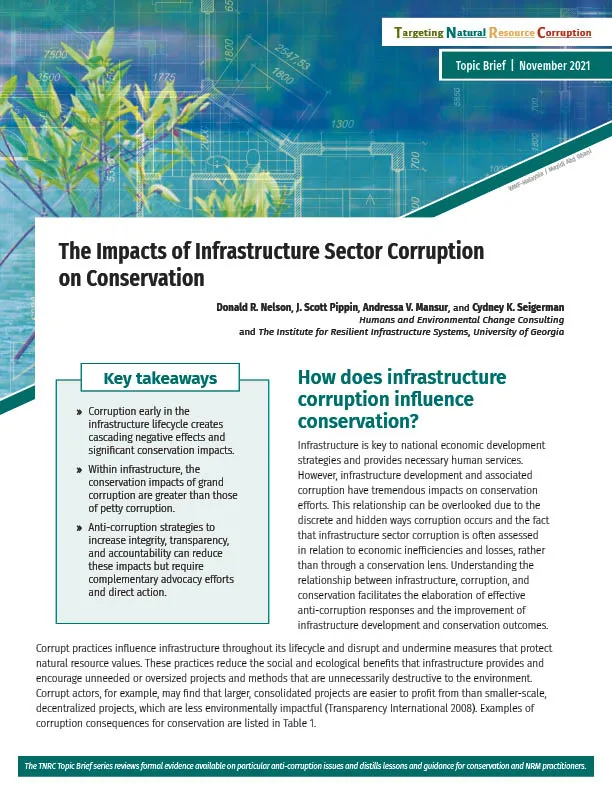
Corruption early in the infrastructure lifecycle creates cascading negative effects and significant conservation impacts. Within infrastructure, the conservation impacts of grand corruption are greater than those of petty corruption. Anti-corruption strategies to increase integrity, transparency, and accountability can reduce these impacts but require complementary advocacy efforts and direct action.
---
This content is made possible by the generous support of the American people through the United States Agency for International Development (USAID). The contents are the responsibility of World Wildlife Fund (WWF) and do not necessarily reflect the views of USAID, the United States Government, or individual TNRC consortium members.
-
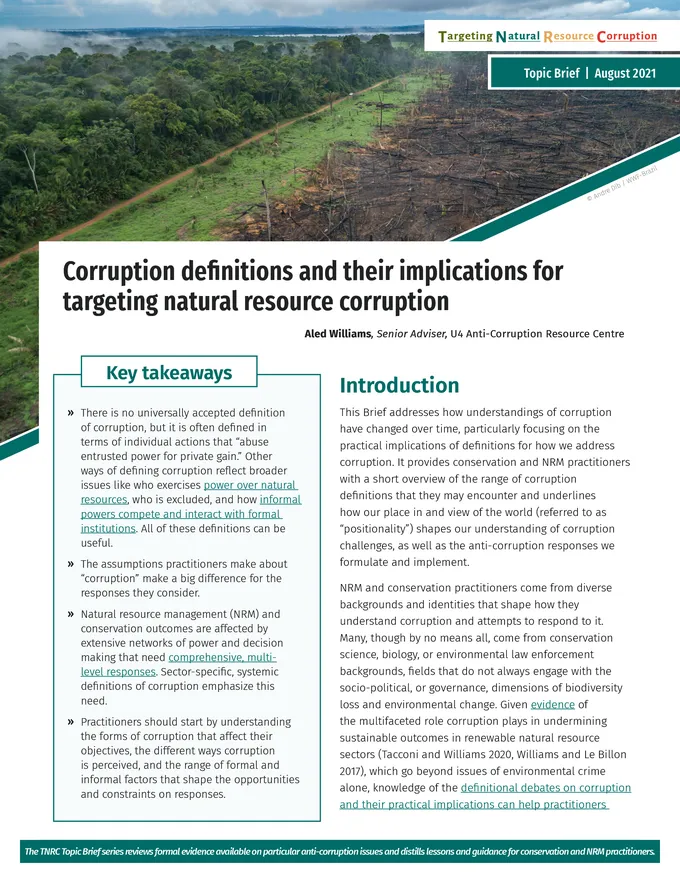
This Brief addresses how understandings of corruption have changed over time, particularly focusing on the practical implications of definitions for how we address corruption. It provides conservation and NRM practitioners with a short overview of the range of corruption definitions that they may encounter and underlines how our place in and view of the world (referred to as "positionality") shapes our understanding of corruption challenges, as well as the anti-corruption responses we formulate and implement.
For more resources, go to the Targeting Natural Resource Corruption project's Knowledge Hub.
---
This content is made possible by the generous support of the American people through the United States Agency for International Development (USAID). The contents are the responsibility of World Wildlife Fund (WWF) and do not necessarily reflect the views of USAID, the United States Government, or individual TNRC consortium members.
-
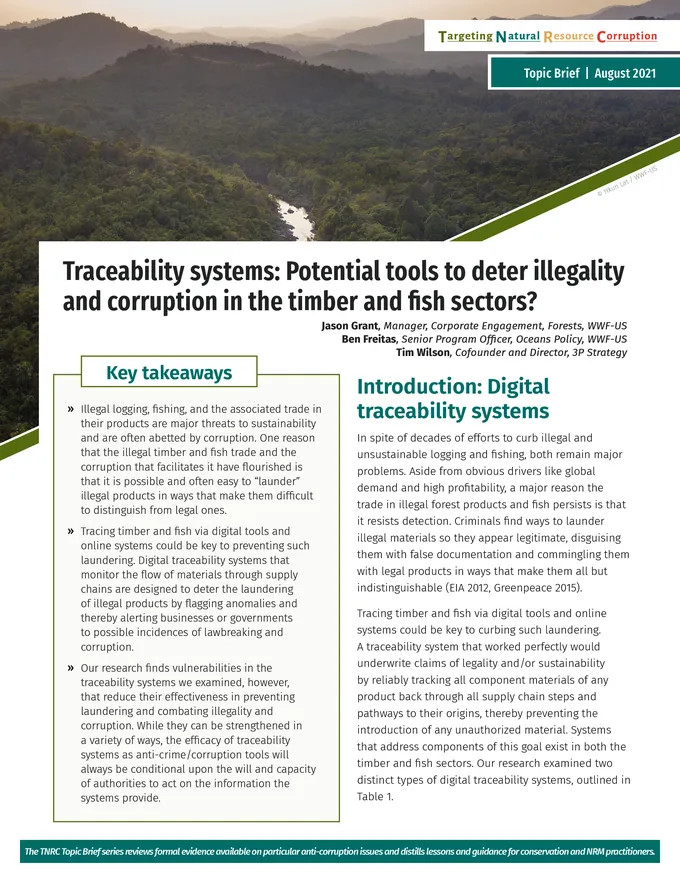
Illegal logging, fishing, and the associated trade in their products are major threats to sustainability and are often abetted by corruption. One reason that the illegal timber and fish trade and the corruption that facilitates it have flourished is that it is possible and often easy to "launder" illegal products in ways that make them difficult to distinguish from legal ones. This Brief finds vulnerabilities in some traceability systems that reduce their effectiveness in preventing laundering and combating illegality and corruption. While they can be strengthened in a variety of ways, the efficacy of traceability systems as anti-crime/corruption tools will always be conditional upon the will and capacity of authorities to act on the information the systems provide.
For more resources, visit the Targeting Natural Resource Corruption project Knowledge Hub.
---
This content is made possible by the generous support of the American people through the United States Agency for International Development (USAID). The contents are the responsibility of World Wildlife Fund (WWF) and do not necessarily reflect the views of USAID, the United States Government, or individual TNRC consortium members.
-
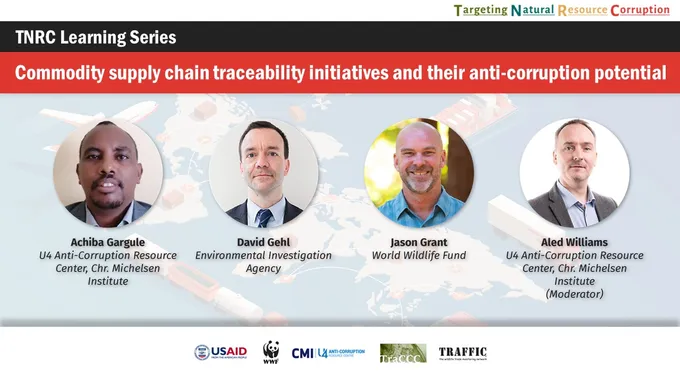
This presentation deck is rom a TNRC Learning Series Webinar on 18 June 2021 on commodity supply chain traceability initiatives and their anti-corruption potential. This webinar addressed the following learning questions: 1. Which forms of corruption and associated crimes in the wildlife, timber and/or seafood sectors could traceability systems address, and which forms might they not? 2. What are the strengths and weaknesses of traceability systems at their current stage of evolution, and what are their major limitations for addressing corruption? 3. How could traceability systems, and supporting approaches, mature to better accomplish anti-corruption objectives? 4. What actions could NRM practitioners and others take to help traceability initiatives become more effective as anti-corruption tools in the future?
---
This content is made possible by the generous support of the American people through the United States Agency for International Development (USAID). The contents are the responsibility of World Wildlife Fund (WWF) and do not necessarily reflect the views of USAID, the United States Government, or individual TNRC consortium members.
-
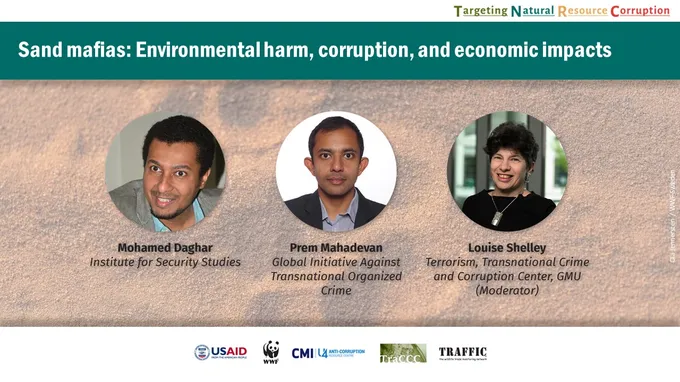
This presentation is from a TNRC virtual panel on June 14, 2021 in which speakers from Kenya and India discussed an understudied, yet environmentally devastating trend: the unsustainable mining of river sand, facilitated by corruption, that feeds the global construction boom while destroying habitats and livelihoods and fueling conflict.
---
This content is made possible by the generous support of the American people through the United States Agency for International Development (USAID). The contents are the responsibility of World Wildlife Fund (WWF) and do not necessarily reflect the views of USAID, the United States Government, or individual TNRC consortium members.