How temporary water sources connect wildlife across southern Africa
Restoration of ephemeral water sources—called pans—helps people and animals thrive
© Derek Volmer/WWF-US
Key takeaways
- Water is a critical resource that guides where wildlife moves across landscapes and supports nearby communities.
- Restoring degraded ephemeral water sources, called pans, improves water availability by helping retain seasonal rainfall for longer.
- Strategic restoration could reduce conflict between people and wildlife by providing water in the right places for both.
Across vast landscapes like the Kavango Zambezi Transfrontier Conservation Area (KAZA)—a massive conservation area spanning parts of five southern African countries—access to water is critical to habitat connectivity, allowing animals to move among feeding areas, breeding grounds, and seasonal habitats. But water is becoming more precious across southern Africa as climate change brings more frequent droughts, less predictable rainfall, and hotter temperatures. When water becomes scarce, wildlife and people are more likely to rely on the same sources, increasing the potential for human-wildlife conflict. Strategic restoration of ephemeral water sources, called pans, could help address these challenges by improving water availability for people and wildlife in different places while maintaining the natural connections wildlife depend on.
1. What exactly is a pan?

© Derek Volmer/WWF-US
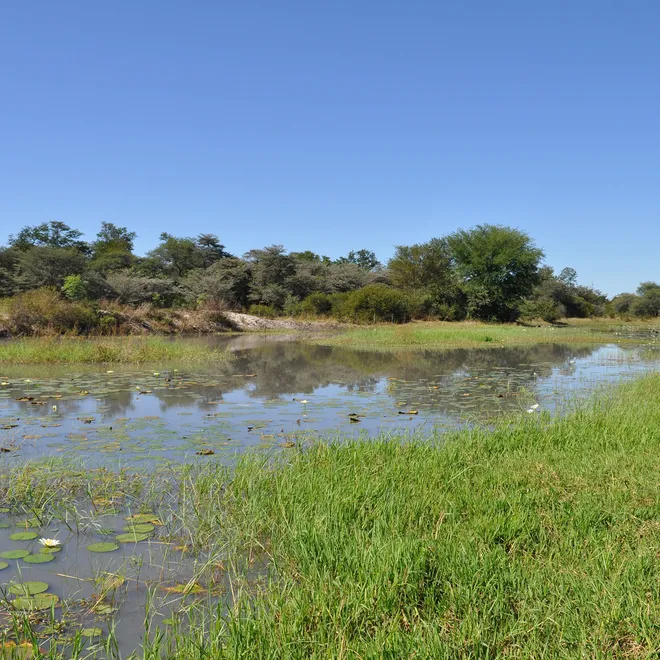
Pans are shallow ephemeral (temporary) wetlands that collect water mostly from seasonal rains and sometimes from floodwaters, transforming dry depressions into temporary oases that sustain wildlife, plants, livestock, and nearby communities.
African savanna elephants depend on pans as a necessary water source, according to research coauthored by WWF scientists and the 2026 mapping of the entirety of KAZA (approximately 200,733 square miles). But after two years of drought, many of the pans did not fill with water in 2024.
2. Restoring a pan follows natures blueprint
Healthy pans often contain a natural clay layer that helps hold water near the surface. Over time, however, land degradation and erosion can fill these depressions with sediment, reducing their ability to store water.
Restoration aims to recover natural processes by removing excess sediment, reestablishing vegetation around the pan, and sometimes installing small structures that slow runoff and keep water on the landscape longer.
3. Animals move where there is water, and so do people

© Jasper Doest/WWF
During the wet season, pans allow wildlife to spread beyond permanent rivers and access food and habitat across much larger areas. Temporary water sources like pans are among the strongest drivers of where elephants and buffalo move across KAZA1. And in 2026, WWF researchers placed GPS collars on 27 elephants and mapped exactly which watering holes they visited.
But with fewer pans filling and remaining filled because of drought and sedimentation, wildlife, livestock, and people are competing over water more often. Now scientists want to learn more about providing separate, additional water for people and wildlife in key areas. This could include pan restoration, rainwater harvesting, and boreholes—deep, narrow wells used to reach groundwater.
4. Restoring pans in the right places can help people and wildlife share the landscape
The maps that scientists built of KAZA’s pans and other ephemeral surface water, combined with the GPS tracking of elephants, can help identify the best places for pan restoration2. Restoring pans along natural wildlife movement routes can help animals find water where they normally travel. At the same time, restoring water sources near communities and developing separate water supplies for people and their livestock can reduce the need for wildlife and people to rely on the same places.
When water is available in the right locations, wildlife can move more freely across the landscape, and communities have more reliable access to water closer to home. In this way, inland waters are an important part of habitat connectivity. Restoring pans in strategic locations is one piece of the puzzle conservationists are solving to reconnect movement pathways for wildlife while reducing competition over water across KAZA.
© WWF-US / WWFGifts
Adopt an African elephant
Support WWF’s global efforts to protect wild animals and their habitats and choose from kits with plush and more.