What you need to know about tipping points
These changes can severely damage our planet’s life-support systems, but nature has positive tipping points too
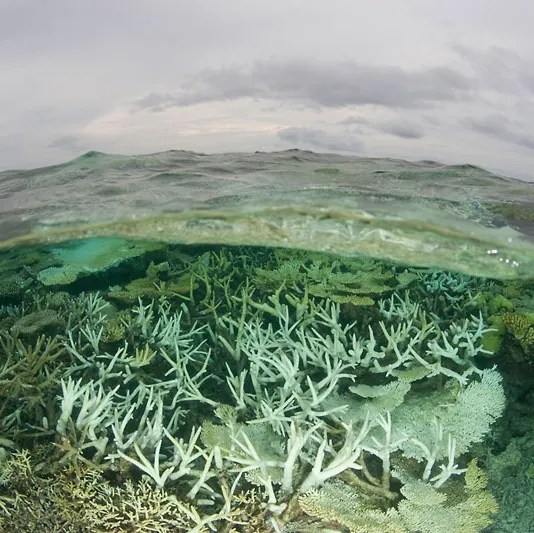
© Jürgen Freund / WWF-Canon
In April 2024, the National Oceanic and Atmospheric Administration made a grim announcement: the world’s coral reefs were in the throes of another global bleaching event. Bleaching—when corals become so stressed by rising ocean temperatures that they expel the symbiotic algae they need to survive—has already been confirmed in 83 countries, affecting more than 84% of the world’s coral reefs, from Australia’s Great Barrier Reef to Florida and the Caribbean.
It is the fourth such occurrence in 30 years and the most extensive bleaching event to date.
“Almost every year, you read another story about how the bleaching event is even worse than it was last year,” says Rebecca Shaw, Chief Scientist and Senior Vice-President of WWF’s Global Science division. “I think we are approaching the very cusp of a tipping point.”
What are tipping points?
Some environmental systems, such as coral reefs, undergo profound upheavals due to global warming, pollution, and the over-exploitation of natural resources. When sufficient changes accumulate over time, they can push the system beyond a critical threshold—called a ‘tipping point’—into a completely new state. This drastic transformation happens abruptly, and triggers cascading feedback loops that accelerate the process, often leading to irreversible changes in the system.

© Jacqueline Lisboa / WWF-Brazil
Why do tipping points matter?
Researchers have so far identified more than 20 tipping points1, or systems that are close to the edge. If triggered, the changes will severely damage our planet’s life-support systems.
Apart from coral reef ecosystems collapsing, the most worrisome tipping points today include:
- The shut-down of ocean mixing in the North Atlantic could shift global climate patterns and bring about more extreme weather. If this system of ocean currents—which moves warm water from the tropics to the North Atlantic—collapses, there will be rapid and drastic changes to the climate and sea levels.
- The die-back of the Amazon could turn the world’s largest rainforest into a dry, degraded savannah, resulting in rapid biodiversity decline and the loss of a major carbon sink.
When one tipping point is crossed, it could trigger others, causing a domino effect. The melt-off of glaciers and ice-sheets, for instance, would pour freshwater into the sea and further weaken ocean circulation.
What are positive tipping points?
It’s not all bad news, however. The same dynamics that can push natural systems toward collapse can also accelerate positive change. “For a long time in scientific literature, we talked about tipping points as being catastrophic and how we’re just victims to them,” says Shaw. “But there are social tipping points too, which can be really positive.”
A positive tipping point occurs when a system crosses a threshold into a healthier state, and the change begins to reinforce itself through feedback loops. Examples include the rapid growth of renewable energy, the shift toward electric vehicles, and an overall greater investment in green technologies.
These changes are not inevitable, and reaching a tipping point can take years or even decades of policy support, investment, innovation, and persistence. But once the right conditions are in place and a positive tipping point is crossed, change can begin to accelerate, becoming faster, cheaper, and harder to reverse.
“The world is always going to change,” says Sam Cheng, Director of Conservation Evidence of WWF’s Global Science team. “The question is whether or not we can try and trigger these positive tipping points in a way that brings us back to more of a natural state of change.”

© WWF-US/Abel Valdivia
How is WWF responding to tipping points?
WWF works to prevent negative tipping points while helping create the conditions for positive ones. That means addressing pressures that put ecosystems at risk, while also looking at the larger systems that shape how people use resources, make decisions, and invest in solutions.
Pulling back from the precipice of negative tipping points isn’t easy, Cheng admits. “These are complex problems that don’t always have a straight answer, and the sheer scale of some of these global challenges can be very overwhelming.”
To that end, WWF is working with governments, businesses, local community groups, civil society organizations and others to protect and restore ecosystems and address the underlying drivers of environmental change. This includes raising public and private sector funding to support and protect large-scale conservation, working with communities on agricultural and aquaculture systems, and supporting conservation in places where it can have the greatest impact.
Additionally, WWF’s Global Science team works with program teams and implementing partners worldwide to “think about how we design durable and sustainable solutions,” says Cheng. “So not just thinking about the types of conservation actions that may be implemented on the ground, whether that’s restoring habitat corridors for animal migration, but thinking about the enabling conditions for them.”
Throughout this work, one thing is always on the forefront of their minds: equity. “Really making sure how we step away from those negative tipping points is inclusive,” Cheng explains, “and that the consequences of doing so don’t end up with adverse effects for the people who are least able to pay those costs.”
What can you do to help?
Tipping points can sound like a reason to despair, but the important thing to remember is that it isn’t too late to take action. “We can still pull back from negative tipping points. It hasn’t gone over the edge where it can’t be retrieved,” says Shaw. “It’s a bit like being unhealthy—when you start taking care of yourself again, you can get healthy and thrive. The same is true for the planet.”
Encouragingly, we already have many of the tools we need to reduce pressure on nature, she says. But we have to “move quickly to put into motion the changes that will bear fruit in the next 15, 25, and 35 years.”
As individuals, we can make choices that contribute to larger shifts. For instance, being more mindful about consuming food that is sustainably sourced and wasting less of it. Or by switching to renewable energy, be it installing solar panels or purchasing an electric vehicle.
“Positive tipping points give us a lot of opportunity to exercise our own agency to create the world we want,” says Shaw. “The challenge over the next several years is recognizing where positive change can accelerate and then working together to move our planet toward that healthier future."