
From valuing nature to investing in it: a challenge for Ministries of Finance
Connecting economic research, country experience and investment priorities to bring nature into fiscal and financial decision-making.
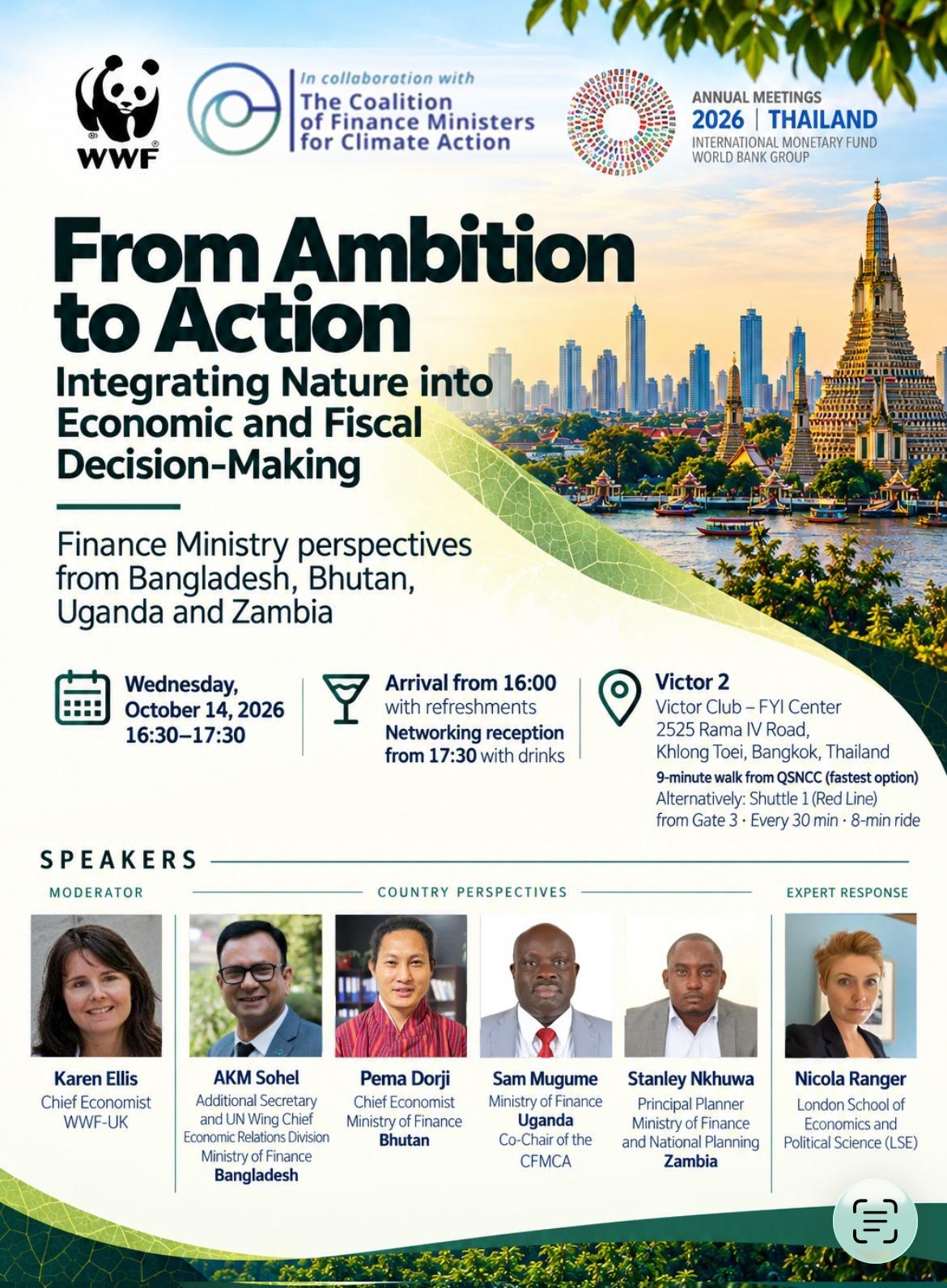
In October 2026, finance officials from around the world gathered in Bangkok, Thailand, for the annual meetings of the International Monetary Fund and World Bank. As part of the week’s events, WWF-US and WWF-UK partnered with the Coalition of Finance Ministers for Climate Action—a group of governments working to integrate climate considerations into economic policy—to explore how Ministries of Finance can move beyond measuring nature’s economic value to addressing the risks of its decline, identifying investment priorities and securing the financing needed to protect it.
By
-
and Karen Ellis

© Olha Krushelnytska / WWF
A thriving economy depends on a healthy natural environment. Forests, watersheds, wetlands and fertile soils support agriculture, infrastructure, energy generation and economic resilience. Yet their contribution—and the costs of their degradation—often remain insufficiently reflected in economic policy and public investment decisions.
A growing body of research is changing this perspective. The World Bank’s Changing Wealth of Nations, which tracks countries' economic assets, including natural resources, demonstrates why GDP alone cannot capture changes in the assets underpinning long-term prosperity. Nature’s decline puts these assets at risk: a landmark global assessment by an international panel of biodiversity scientists has documented species extinction rates at least tens to hundreds of times higher than the average over the past 10 million years, with the rate accelerating. The economic implications are substantial. Research by PwC estimates that over half of global GDP—approximately US$58 trillion—is moderately or highly dependent on nature, making it particularly vulnerable to ecosystem degradation.
Reflecting these risks, the World Economic Forum’s 2026 Global Risks Report ranks extreme weather events, biodiversity loss and ecosystem collapse, and critical change to Earth systems as the three most severe global risks over the next ten years. WWF’s Living Planet Report 2026 highlights that the hidden environmental and health costs of agriculture and food systems exceed US$10 trillion annually.
Recent research by the Paulson Institute, The Nature Conservancy and WWF estimates the global biodiversity financing gap —the difference between what is currently spent on protecting nature and what is needed—at approximately $1.3 trillion annually. Meanwhile, the Organisation for Economic Co-operation and Development (OECD) emphasizes that financial innovation alone is insufficient without effective public policies and institutions to support it.
Ministries of Finance are increasingly recognizing the growing economic costs of nature loss, and the need to invest in the natural assets that underpin a healthy economy. However, this represents a new and technically challenging topic for them.
This requires moving beyond measuring nature's economic value to understanding the risks of its decline, identifying where investments are most needed and determining how to pay for them.
This was the focus of a discussion organized by WWF-US and WWF-UK in collaboration with the Coalition of Finance Ministers for Climate Action, a group of governments working to integrate climate considerations into economic policy. The discussion took place in Bangkok in October 2026, alongside annual meetings of the International Monetary Fund and World Bank that bring together finance officials from around the world.
Finance Ministry representatives from Bangladesh, Bhutan, Uganda and Zambia shared their experiences of bringing nature into economic and fiscal decision-making. Their perspectives illustrated different approaches:
- Zambia is developing natural capital accounts to measure the economic value of resources such as forests, land and water, helping inform development planning and investment priorities.
- Uganda is using similar accounting methods to inform government budgeting and assess how changes in natural resources affect the broader economy and public finances.
- Bhutan is advancing Gross Ecosystem Product assessments, which measure the economic value of benefits provided by nature, to inform national development and public investment decisions.
- Bangladesh is building on its experience tracking climate-related government spending while working to turn national priorities into specific projects with clear costs and financing plans.
From evidence to economic decisions
Despite different starting points, the countries highlighted three interconnected challenges.
Understanding and managing risks. Governments need to assess how ecosystem degradation affects productivity, infrastructure, public finances and debt sustainability—and incorporate these risks into economic analysis.
Planning and prioritizing investments. Better information alone does not determine where to invest. Ministries of Finance need to assess the costs, economic benefits and trade-offs of investments in natural systems alongside competing development priorities.
Mobilizing and managing finance. Economically beneficial investments do not necessarily generate commercial returns. Governments need to determine appropriate roles for public budgets, development banks and private investors, while managing fiscal risks.
These challenges require different capabilities and practical solutions. They also require stronger collaboration between Ministries of Finance, Environment and Planning, researchers and financial institutions.
Turning country experience into broader progress
Building on lessons from Bangkok and other country experiences, WWF aims to work with the Coalition of Finance Ministers for Climate Action, interested governments, economists and development banks, to translate nature-related economic analysis into investment priorities and, ultimately, pipelines of viable projects that can attract public and private financing.
The next frontier is not simply demonstrating that nature has economic value. It is making that value relevant to the choices governments make about risks, budgets, investments and finance.