Rotten Fish 2.0: Corruption undermining sustainable fisheries, and what WWF is doing about it
By
-
Preston Whitt

© WWF-US/Mac Stone
Illegal, unreported, and unregulated fishing (IUU) is a multi-billion-dollar problem, and corruption is the grease that allows those billions to disappear into dirty pockets. Corruption can begin before vessels leave shore, with registration in flags of convenience to avoid oversight or bribes for officials to overlook violations of labor laws when hiring (or forcibly "recruiting") crewmembers. It can occur throughout the supply chain, to launder illicitly caught fish into the supply chain at landing or processing. And it can appear at the point of final consumption, with customers paying more for a desirable, local, sustainably managed fish species but actually receiving a cheaper, imported, and/or endangered alternative — if their seafood is even seafood at all.
In 2019, the United Nations Office on Drugs and Crime (UNODC) published Rotten Fish: A Guide on Addressing Corruption in the Fisheries Sector. That foundational work inspired, informed, and guided many parallel and subsequent initiatives, including the Targeting Natural Resource Corruption project. WWF led this project until its conclusion in 2024, with the knowledge and expertise it produced being embedded across WWF teams and offices.
WWF and UNODC's partnership in Ecuador began in 2023 and focused on improving maritime security. Anti-corruption is a necessary component for such improvements to be effective and lasting.
Now, in September 2026, UNODC has released a second edition of Rotten Fish, and WWF joined the many other experts who reviewed and contributed to it. This new edition draws from Rotten Fish’s valuable insights and WWF’s years of work on preventing illegal, unreported, and unregulated fishing, and advancing a nature-positive blue economy—which aims to halt and reverse ocean biodiversity loss by 2030 by transitioning industries to sustainable practices that restore, rather than merely protect, marine ecosystems. Here are three key implications for programming at the intersection of ocean conservation and corruption prevention.
© UNODC
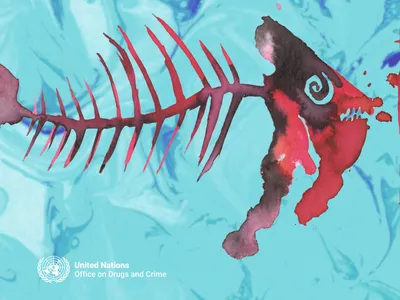
Rotten Fish: Second Edition
A guide on addressing corruption in the fisheries sector
Read the reportUnderstand root causes and motivations
One of the most practical conceptualizations of corruption is “functionality”: what problem is corruption (or other illicit behavior) “solving” for regular people? Is a bribe the only way to get a fishing license in a reasonable amount of time? Is agreeing to transport contraband the only way to avoid threats from organized criminals? This approach does not excuse illicit acts (least of all for the powerful bad actors more firmly motivated by “greed”), but rather seeks to understand the incentive structure and the needs and challenges people face.
This understanding is a crucial first step to both good anti-corruption and good conservation work. That is why Rotten Fish recommends carefully “involving external stakeholders” who “bring diverse perspectives, technical expertise, and contextual knowledge” that “can help identify blind spots” and “promote solutions that are more responsive to real-world conditions.”
That is also why the WWF-US Oceans team focuses on “embracing community-led conservation…with conservation priorities identified by the people living and working with nature.” Fisheries improvement projects encourage “collaboration and communication with coastal communities to find the most suitable path to success” and, to be successful, must consider “human wellbeing and environmental sustainability in tandem. “Jurisdictional initiatives,” which apply ecosystem-based and science-based target approaches to ocean health, ensure that a wide range of stakeholders with diverse perspectives are meaningfully engaged throughout the project lifecycle, so that activities are appropriate to the sociopolitical context of the fishery or aquaculture farms. Meeting stakeholders where they are and collaborating to identify solutions is the only lasting way to achieve the kind of improvements our global life support system needs.
In this episode of WWF's Nature Breaking podcast, Director for the Western Indian Ocean Seascape Shauna Mahajan discusses locally led conservation in that region. One specific tool she mentions using is Elinor, which is an open-access, participatory tool
Make it harder / costlier to do wrong, but don’t forget to make it easier / cheaper to do right
Both anti-corruption and conservation initiatives often try to shift actors’ cost-benefit calculations. This can involve raising costs by increasing the likelihood of getting caught (e.g., transparency, increased sea patrols) or calibrating punishments to fit the misdeed (e.g., “proportionate and dissuasive” IUU sanctions), as well as reducing the benefits of wrongdoing by making it harder to profit from illegality (e.g., import control schemes that prohibit IUU imports). Paired efforts to raise the benefits of doing the right thing are also important, like “integrity awards” (when complemented by broader normative nudges) and safe, easy, trusted options for whistle-blowing (with strong protections that safeguard individuals from retaliation and risks).
Other areas of the Oceans team’s work are less about right or wrong behaviors, and more about environmentally “better” or “more sustainable” alternatives. We therefore focus a lot on making, in a contextually appropriate way, those positive changes easier and cheaper (even, in some cases, downright profitable!). Examples include building demand for the use (and effective management of) more abundant, less ecologically sensitive species; helping local fishing communities earn more for their catches if they follow management rules (that they help write); and developing easier, lower-cost solutions to help fishers avoid entangling birds, turtles, and whales. On the financial side, we help businesses “price in”, mitigate, and ultimately transform their impacts and dependencies on nature, and we work with investors and financial institutions so that they understand the risks to their bottom line from inaction and move towards long-term sustainable returns.
Finally, technology and innovation can play key roles in both conservation and anti-corruption, but technology alone is not a panacea. Traceability systems, for example, “track fish from the moment they are caught until they enter the market,” but achieving their goal of “helping to prevent mislabeling and sale of illegally caught fish” is “conditional upon the will and capacity of authorities [and businesses!] to act on the information the systems provide.” Similarly, electronic monitoring (EM) on vessels, as an alternative to on-board observers, can be an effective, safer, and cheaper means for responsible governments and ship owners to track what happens at sea. But EM “requires a clear, well-thought-out governance design” to be effective, deciding policies and procedures like who has access to EM data and how EM records are cross-checked and verified.
This video features Jean Richard Bezandry, President of Tazara Shipowners and Small-Scale Fishers Association, discussing the deployment of Shellcatch EM on their artisanal vessels as part of a project with WWF Madagascar. Broader government anti-corruption efforts, including improvements supported by TNRC in Madagascar, help make sure that the data Shellcatch and other technologies provide are used appropriately and effectively.
Respond holistically and systemically
Both corruption and environmental degradation are systemic challenges, meaning they are complex, dynamic, multi-actor, and multi-scalar. Systemic challenges require systemic, holistic solutions. Rotten Fish calls for a “whole-of-society approach” with integrated efforts across prevention, detection, and enforcement. The WWF US Oceans team takes just such a holistic, integrated, multi-scalar, -actor, and -sector approach to conserving our oceans.
For example, our longstanding work to transform ocean-relevant markets coordinates actors across supply chains (e.g., seafood traceability from catch to consumption), sectors (e.g., from offshore renewable energy to coastal tourism), and social dimensions (e.g., seafood producers and the communities dependent on, affected by, and contributing to their operations). In particular, we work with some of the world’s largest seafood buyers to help them commit to sourcing from fisheries and aquaculture farms that meet voluntary standards and measures (such as MSC/ASC, ISSF, and GDST). Companies set concrete targets for sourcing and work to support needed improvements in their source fisheries and farms in tandem with local producers and managers. We accompany these companies in their journeys to help measure progress and ensure accountability and impact.
Our Blue Peace and Security framework is another perfect example. WWF’s work protecting oceans leverages “marine natural resources as a catalyst for peace and resilience” by transforming and inverting the interconnected challenges of nature loss, insecurity, and conflict. Blue Peace demonstrates how WWF works holistically and systemically: across governance levels (from coastal communities to regional fisheries management organizations), across spatial decision making (like where to site protected areas, aquaculture farms, or coastal development), and across common fracture lines (like artisanal and industrial or fishers and marine megafauna). Throughout it all, we maintain focus on both human and natural security, prosperity, and resilience.
That resilience is what must underpin lasting conservation in the ocean. And lasting conservation in the ocean (and everywhere) requires integrity, fairness, rule of law, peace, and justice: attributes that cannot coexist with corruption. If we all continue to incorporate these perspectives into our work, the fisheries-specific anti-corruption guidance in this new edition of Rotten Fish promises to be as valuable to the field of sustainable fisheries as the first.