In Viet Nam, rescued tigers find a safe haven
By
-
Sandy Ong

© WWF-US / Justin Mott
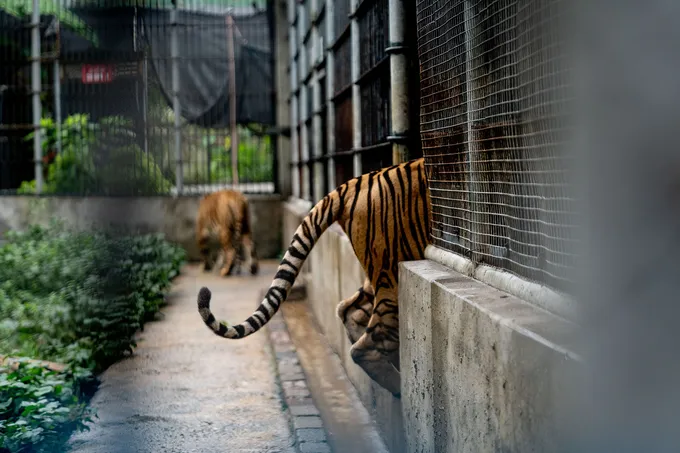
Behind a large house, six tigers pace about inside a concrete enclosure. It’s morning in northern Viet Nam’s hilly Thai Nguyen province, but the heat is already blistering.
The strangers in the backyard—a team comprising animal experts from Hanoi Wildlife Rescue Center, alongside representatives from the forest protection department—are here to move the tigers to their new home, but the tigers were agitated by the team’s presence.
To calm them down, the big cats’ owner offered up their favorite foods—whole chicken and large chunks of beef. It’s a poignant moment for the middle-aged man: "For nearly 20 years, I have treated them as my own children,” the owner said. “But I'm getting older, and my health is no longer stable, so our family has decided to voluntarily hand over the tigers to a trustworthy place, so they could be raised for the rest of their lives.”
That place is the Hanoi Wildlife Rescue Center, situated in the country’s capital, roughly an hour and a half’s drive away. The state-run facility is one of 23 animal rescue centers in Viet Nam and the only one equipped to offer a haven to both surrendered tigers like these and those confiscated by authorities.
Across Viet Nam, nearly 400 tigers are kept in captivity in zoos, safaris, and privately owned facilities, where individuals raise the animals as pets. However, there are also a significant number of tigers kept in illegal basement farms—often smuggled into the country from neighboring Lao PDR, Cambodia, and Thailand—to be raised as pets or for slaughter as part of the lucrative illegal trade in their parts.
© WWF-US / Justin Mott

© WWF-US / Justin Mott
Tigers are an endangered species, and it is illegal to hunt, keep, or sell the big cats in Viet Nam. Still, the tiger trade continues to flourish in some parts of Asia, driven by a demand that sees all parts of the tiger used, including bones that are used in traditional medicine to purportedly cure ailments such as arthritis or to make ‘glue’ that is mixed with wine for consumption and claws, teeth, skin and even whiskers that are prized as amulets or decorative curios.
When tigers are confiscated from the illegal trade or voluntarily surrendered by owners, they are transported to the Hanoi Wildlife Rescue Center where they are cared for, alongside other rescued animals, like birds and reptiles. Since it opened its doors in 1996, the center has received and rescued more than 32,000 individuals comprising over 100 different species ranging from sun bears to white-cheeked gibbons.
“Rescued animals are usually not in a very healthy state, pretty inactive, and are often scared of other animals,” says center director Luong Xuan Hong. So vets give new arrivals a thorough check-up to detect any injuries or diseases, before coming up with a suitable rehabilitation program, which includes activities to help them retain their natural instincts.

© WWF-US / Justin Mott
Once they’re healthy, some species—including Sunda pangolins, big-headed turtles, and king cobras—are released back into the wild, in various national parks dotted around the country.
"For animals like these rescued tigers, there is no potential for their release to the wild, and they are dependent on rescue centers such as the Hanoi Wildlife Rescue Center to provide secure and long-term care,” says Michelle Owen, WWF’s chief of party for the USAID Saving Threatened Wildlife project, which is working with the Vietnamese government to tackle wildlife trafficking.
On a recent overcast summer afternoon, a handful of tigers took dips in concrete pools of water, lounged about large foliage-filled enclosures, and pawed at bunches of leaves hanging from cage tops in the midst of tranquil surroundings. Once their quarantine period is over, the six tigers (three male, three female) from Thai Nguyen will join their fellow big cats, their days no longer confined to cramped, concrete quarters at the back of someone’s house.
“They’re doing a great job,” says Owen of the center. “But they’re at capacity.” Thankfully, plans are underway to expand the 2.5-acre site.
In addition to working with the rescue center, Owen and her team are also assisting the Viet Nam government in compiling the country’s first-ever DNA database of captive tigers, which records the cats’ unique genomic profiles alongside their fur stripe patterns. The aim? To help authorities ensure captive facilities are properly managed and monitor any movement of tigers in order to minimize any threat of the tigers being trafficked for their parts, all part of their efforts to protect Asia’s precious remaining wild tigers.