Publications
-
These Resource Guides introduce some foundational principles and common considerations for research into conservation-focused anti-corruption actions.
Part I introduces three "packages" of research that introduce non-specialists to some of the relevant core approaches and methods for assessing whether, when and how social norms might be targeted to address corrupt behaviors. When combined, the packages provide quantitative measures for pivotal values – e.g., social tolerance of and attitudes towards corruption, or the percent of a sample who have paid a bribe – against which progress with anti-corruption actions can later be measured (the "baseline"). The arising data will also provide qualitative information to help guide choices around the SNBC strategies to adopt ("formative" insight).
Part II introduces two "packages" of research that introduce non-specialists to some of the relevant core approaches and methods for assessing and adaptively managing social norm and behavior change approaches and understanding whether they have achieved the overall aims, goals, and ambitions.
See more resources from the TNRC Knowledge Hub.
---
This content is made possible by the generous support of the American people through the United States Agency for International Development (USAID). The contents are the responsibility of World Wildlife Fund (WWF) and do not necessarily reflect the views of USAID, the United States Government, or individual TNRC consortium members.
-
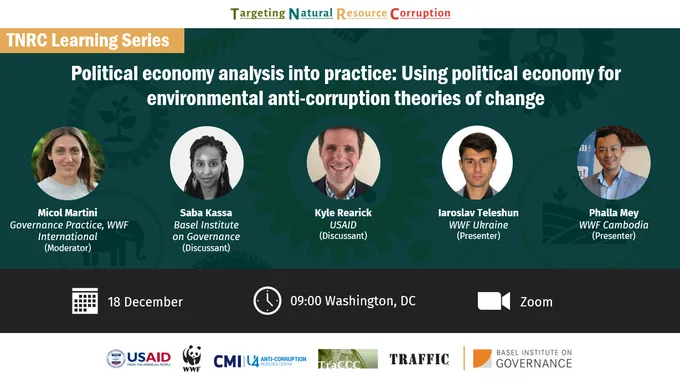
This presentation deck is from a TNRC Learning Series webinar introducing a new guide on Integrating Political Economy Analysis (PEAs) findings into theories of change (ToC) to address corruption that undermines conservation objectives. The webinar was held on 18 December 2023. Panelists discussed the utility of PEAs for designing, testing, or adapting ToCs, identified challenges to using PEA, what conditions have enabled uptake, and offered insights into context-specific PEA approaches and their applications.
---
This content is made possible by the generous support of the American people through the United States Agency for International Development (USAID). The contents are the responsibility of World Wildlife Fund (WWF) and do not necessarily reflect the views of USAID, the United States Government, or individual TNRC consortium members.
-
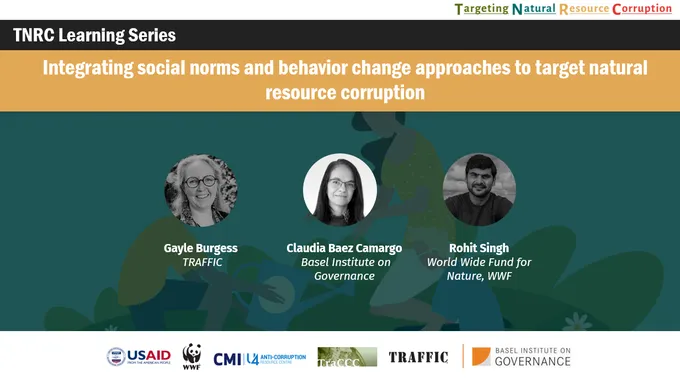
These slides are from a TNRC Learning Series webinar from the Basel Institute on Governance. The webinar shares learning from a series of forthcoming tools and examples for adopting social norm and behavior change (SNBC) approaches to address natural resource corruption.
---
This content is made possible by the generous support of the American people through the United States Agency for International Development (USAID). The contents are the responsibility of World Wildlife Fund (WWF) and do not necessarily reflect the views of USAID, the United States Government, or individual TNRC consortium members.
-
This TNRC guide suggests six steps for bringing political economy analysis (PEA) findings into a theory of change (ToC) for a project or program. It aims to provide a practical means for conservationists to navigate political economy (PE) in contexts where they work. While a ToC explains the logic of a project, a PEA, which looks at the influence of power, helps get to the heart of what needs to change for a project to work. But practitioners often find it challenging to use PEA in practice.
---
This content is made possible by the generous support of the American people through the United States Agency for International Development (USAID). The contents are the responsibility of World Wildlife Fund (WWF) and do not necessarily reflect the views of USAID, the United States Government, or individual TNRC consortium members.
-
This methodological guide, developed by WWF Peru with support from the USAID-funded Targeting Natural Resource Corruption project, serves to assess the corruption risks in the squid and mahi mahi fisheries value chains in Peru. While initially tailored to the specific context of Peru, this guide offers adaptability for broader application across sectors and contexts. It emphasizes and suggests adaptability, allowing users to modify the methodology to suit their specific needs and circumstances, including changing the order of methodological phases, adding more data collection steps, or applying alternative validation methods. This guide provides a simplified, yet comprehensive, overview of the corruption risk assessment process, though it cautions that practical implementation may demand careful planning due to its potentially labor-intensive nature. Ultimately, this guide serves as a valuable starting point for practitioners seeking to conduct similar assessments, drawing from WWF Peru's project experience and organized around four key methodological phases, with information on the sources used to design each part of the process.
---
This content is made possible by the generous support of the American people through the United States Agency for International Development (USAID). The contents are the responsibility of World Wildlife Fund (WWF) and do not necessarily reflect the views of USAID, the United States Government, or individual TNRC consortium members.
-
This guide was developed for program managers and donors who seek to understand and assess the strength of internal control functions in government agencies responsible for enforcing laws against illegal wildlife trade (IWT). It provides detailed steps and guidance based on experience implementing assessments of internal controls, but a scan of the guide may also be helpful for conservation practitioners who want to understand more about how internal controls systems should work to reduce risks posed by corruption. Such an assessment can aid strategic efforts to enhance the integrity of government operations and to reduce the negative impact of corruption on the enforcement of IWT laws. Though this guide focuses on IWT, the same approach can be useful in other areas of natural resource management, such as forests and fisheries.
---
This content is made possible by the generous support of the American people through the United States Agency for International Development (USAID). The contents are the responsibility of World Wildlife Fund (WWF) and do not necessarily reflect the views of USAID, the United States Government, or individual TNRC consortium members.
-
This brief summarizes empirical evidence and learning from U4 research as part of the five-year, USAID-supported, Targeting Natural Resource Corruption (TNRC) Project, which focuses on helping to reduce the role that corruption plays in enabling and exacerbating environmental and social harms. The first part describes the research; the second part summarizes key findings and implications for practice.
---
This content is made possible by the generous support of the American people through the United States Agency for International Development (USAID). The contents are the responsibility of World Wildlife Fund (WWF) and do not necessarily reflect the views of USAID, the United States Government, or individual TNRC consortium members.
-
Does your work focus on community-based natural resource management or involve indigenous peoples and local communities? Are you concerned that corruption is driving negative outcomes? This guide outlines three steps to start building anti-corruption approaches into your conservation programming.
For more resources and tools, visit TNRCproject.org.
---
This content is made possible by the generous support of the American people through the United States Agency for International Development (USAID). The contents are the responsibility of World Wildlife Fund (WWF) and do not necessarily reflect the views of USAID, the United States Government, or individual TNRC consortium members.
-
Does your work focus on addressing climate change? Significant strengthening of governance systems is essential to reduce corruption risks and make climate change policy and finance less vulnerable to corruption. This guide outlines three steps to start building anti-corruption approaches into your conservation programming.
For more resources and tools, visit TNRCproject.org.
---
This content is made possible by the generous support of the American people through the United States Agency for International Development (USAID). The contents are the responsibility of World Wildlife Fund (WWF) and do not necessarily reflect the views of USAID, the United States Government, or individual TNRC consortium members.
-
Does your work focus on addressing illegal logging and associated trade? Are you concerned that corruption is driving deforestation and illegal timber flows? This guide outlines three steps to start building anti-corruption approaches into your conservation programming.
For more resources and tools, visit TNRCproject.org.---
This content is made possible by the generous support of the American people through the United States Agency for International Development (USAID). The contents are the responsibility of World Wildlife Fund (WWF) and do not necessarily reflect the views of USAID, the United States Government, or individual TNRC consortium members.