Publications
-
Sustainable livelihood projects can be vulnerable to corruption risks that may contribute to further social and environmental damage. This guide has been developed for programming designers and implementers aiming to reduce corruption's impact on community-based conservation initiatives. It contains three modules exploring the corruption opportunities, power, and justifications that might manifest in three typical sustainable livelihood interventions. Each module identifies corruption risks in that activity type and anti-corruption responses that have been tried or can be considered to address those risks.
Visit the TNRC Knowledge Hub for more resources.
---
This content is made possible by the generous support of the American people through the United States Agency for International Development (USAID). The contents are the responsibility of World Wildlife Fund (WWF) and do not necessarily reflect the views of USAID, the United States Government, or individual TNRC consortium members.
-
Indigenous communities play an essential role in successful forest conservation. Community Forest Management (CFM) is a tool that promotes the participation of Indigenous peoples in forest conservation and sustainable management by preventing abuses from third parties and community leaders that could act against the common interest. While CFM has led to many positive results, a variety of obstacles inhibit Indigenous communities‚' involvement in CFM-based legal timber harvesting, such as forest-related corruption, a lack of technical and financial support, bureaucratic barriers, and lack of capacity. This Brief aims to help fill knowledge gaps, generating recommendations to strengthen initiatives that promote the participation of Indigenous communities in forest conservation and sustainable management.
Visit the TNRC Knowledge Hub for more resources.---
This content is made possible by the generous support of the American people through the United States Agency for International Development (USAID). The contents are the responsibility of World Wildlife Fund (WWF) and do not necessarily reflect the views of USAID, the United States Government, or individual TNRC consortium members.
-
This paper presents three case studies that portray how Free Trade Zones (FTZ) and Special Economic Zones (SEZ) characteristics contribute both to Illegal wildlife trade and corruption, while also demonstrating that wildlife trafficking is merely an expression of the multiple illicit economies that can take place in FTZs/SEZs in the absence of adequate controls. These cases also demonstrate that the corrupt practices within these areas do not necessarily differ from other forms of corruption happening elsewhere in the country, region, or trade chain. Rather, what makes FTZs/SEZs particularly interesting for illicit trade is the additional layer of opaqueness and complexity that they pose for local authorities.
Visit the TNRC Knowledge Hub for more resources.
---
This content is made possible by the generous support of the American people through the United States Agency for International Development (USAID). The contents are the responsibility of World Wildlife Fund (WWF) and do not necessarily reflect the views of USAID, the United States Government, or individual TNRC consortium members.
-
This presentation deck is from a TNRC Learning Series Webinar on Using political economy analysis to support corruption risk assessments that strengthen law enforcement against wildlife crime.
For more resources from the Targeting Natural Resource Corruption project, visit the Knowledge Hub.
---
This content is made possible by the generous support of the American people through the United States Agency for International Development (USAID). The contents are the responsibility of World Wildlife Fund (WWF) and do not necessarily reflect the views of USAID, the United States Government, or individual TNRC consortium members.

-
This note has a dual focus. First, it summarizes experiences and lessons from conducting CRAs with authorities responsible for investigations and prosecutions of IWT cases in three countries in Africa and Latin America. It seeks to demonstrate the value of adopting a collaborative approach to CRAs, illustrates potential avenues for pursuing such an approach when the right factors are in place, and demonstrates how mapping the criminal justice process provides a solid starting point to identify critical vulnerabilities. The note also highlights factors that might recommend another approach, for example where collaboration cannot be assured.
Second, this note highlights some common risks that emerged from the CRAs in the three countries and that may negatively affect the progress of IWT cases in other countries. Still, corruption risks vary among countries and agency contexts, and it is not always feasible for practitioners to conduct or initiate a CRA. These general insights can help point practitioners to possible vulnerabilities to look out for.
Visit the TNRC Knowledge Hub for more resources.
---
This content is made possible by the generous support of the American people through the United States Agency for International Development (USAID). The contents are the responsibility of World Wildlife Fund (WWF) and do not necessarily reflect the views of USAID, the United States Government, or individual TNRC consortium members.
-
Anti-corruption programming is rarely linear, and sustainable change can take many years. Political contexts can shift, and key actors may cycle in and out of positions of authority. Furthermore, anti-corruption programming is relatively new to the conservation and natural resource management (NRM) sector. This makes the role of monitoring, evaluation, and learning (MEL) in building an evidence base vitally important. This TNRC introductory overview summarizes the approaches that program designers, program managers, and MEL specialists should consider when planning MEL activities. This overview does not address project design considerations.
---
This content is made possible by the generous support of the American people through the United States Agency for International Development (USAID). The contents are the responsibility of World Wildlife Fund (WWF) and do not necessarily reflect the views of USAID, the United States Government, or individual TNRC consortium members.
-
Strategic litigation has emerged as a crucial institutional space for contesting environmental and natural resource management (NRM) policies worldwide. In many contexts where conservation and NRM practitioners work, ineffective environmental regulations and the rule of law deficits have led to irreparable social and environmental damage, such as the diversion of scarce water from pressing local needs and the disruption of fragile ecosystems. Corruption has enabled this damage, undermining regulations and promoting impunity for violating laws or causing harm. This Brief surveys the history of the strategic litigation concept, explores the three trends that have emerged in its use, and closes with a set of anti-corruption lessons for conservation and NRM practitioners.
---
This content is made possible by the generous support of the American people through the United States Agency for International Development (USAID). The contents are the responsibility of World Wildlife Fund (WWF) and do not necessarily reflect the views of USAID, the United States Government, or individual TNRC consortium members.
-
Key Takeaways
- Corruption is a key enabler of the illegal wildlife trade and its effects are not widely understood. Reviewing past cases can offer a way to explore this relationship.
- While red flags of potential corruption were identified, the review of closed wildlife crime court cases alone was not sufficient to identify confirmed instances of corruption.
- To obtain useable information, court case reviews must be complemented with additional information obtained from press articles, relevant experts, and members of the criminal justice system. Specifically, these consultations can help ascertain the barriers that prevent the identification, investigation, and charging of corruption offences in wildlife crime court cases.
- Where feasible and appropriate, practitioners should consider partnering with relevant government agencies to ensure access to court records, and to feed back to those agencies any suspicions of corrupt practices worthy of further investigation.
---
This content is made possible by the generous support of the American people through the United States Agency for International Development (USAID). The contents are the responsibility of World Wildlife Fund (WWF) and do not necessarily reflect the views of USAID, the United States Government, or individual TNRC consortium members.
-
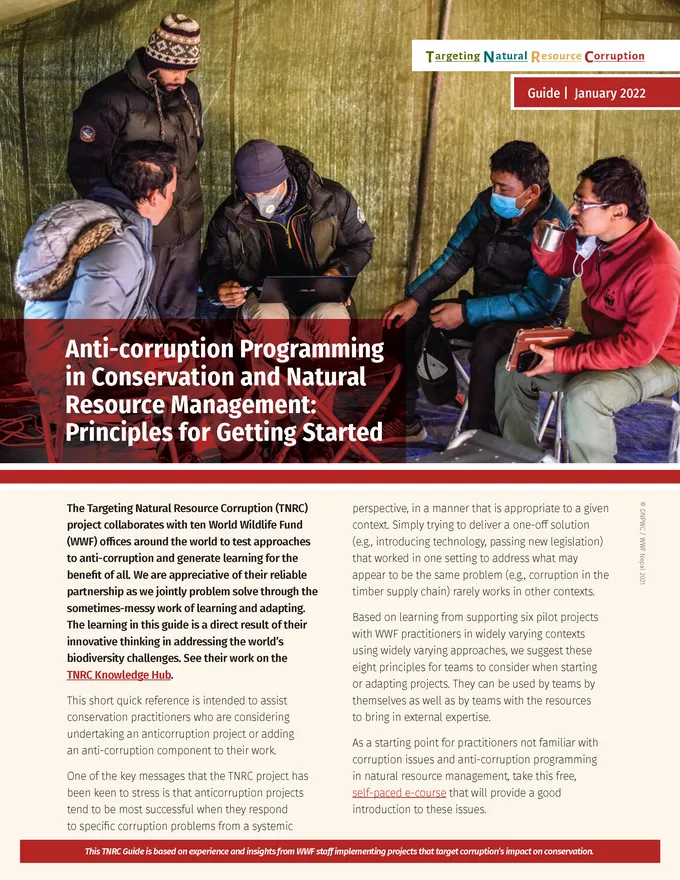
This short TNRC reference guide is intended to assist conservation practitioners who are considering undertaking an anti-corruption project or adding an anti-corruption component to their work. It outlines eight principles based on learning from supporting pilot projects with WWF practitioners in widely varying contexts using different approaches. A key message is that anti-corruption projects tend to be most successful when they respond to specific corruption problems from a systemic perspective, in a manner that is appropriate to a given context.
---
This content is made possible by the generous support of the American people through the United States Agency for International Development (USAID). The contents are the responsibility of World Wildlife Fund (WWF) and do not necessarily reflect the views of USAID, the United States Government, or individual TNRC consortium members.
-
In conservation and natural resource management (NRM), corrupt actions help actors seeking private gain and advantage to sidestep, derail, or even dismantle policies and processes for sustainable management of resources. These actions can take place at the source, when resources are traded, and/or where they are used or consumed. Corruption can be systemic – shaping nearly every aspect of how decisions governing resources are made – and it can also manifest in more singular or opportunistic individual actions and decisions. Importantly, it can exist at any level of a landscape or jurisdiction (country, province, etc.) and it can be related to any formal or informal authorities and functions.
As community-based or inclusive conservation objectives have gained prominence as strategies to achieve and sustain conservation and NRM outcomes, the impact of corruption in local resource management processes has also grown in importance. When local communities, Indigenous peoples, and other actors at national or sub-national levels seek to manage their forests, fisheries, and wildlife resources, they can encounter significant challenges caused by corruption.
---
This content is made possible by the generous support of the American people through the United States Agency for International Development (USAID). The contents are the responsibility of World Wildlife Fund (WWF) and do not necessarily reflect the views of USAID, the United States Government, or individual TNRC consortium members.