Why are wildlife corridors important for lions?
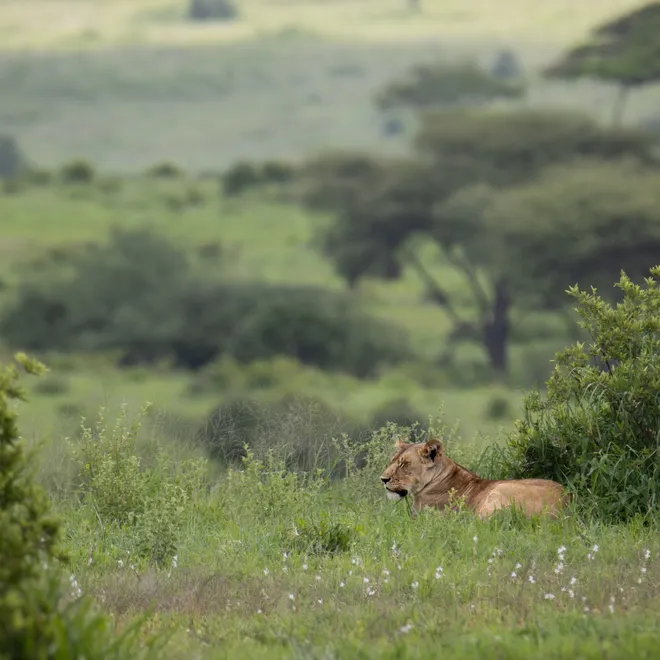
Wildlife corridors connect habitats and help lions move safely between conserved areas
© Kate Vannelli
Key takeaways
- Wildlife corridors connect habitats, enabling lions and other wildlife to move freely in search of food/prey, mates, water, and new territories.
- Connected landscapes are critical to maintaining healthy lion populations while reducing human-lion conflict with the communities they often share space with.

© WWF-US/Gareth Bentley
When people think of a ‘wildlife corridor,’ they might envision a lush, untouched strip of land, devoid of human presence, where animals can travel freely like on a natural highway. However, in reality, wildlife corridors often don’t resemble this perfect image.
A well-established wildlife corridor connects two or more natural habitats, enabling wildlife to move between them. For example, in a lion landscape, a corridor might connect different conserved areas, allowing lions, their prey, and other wildlife to safely move from one area to another in search of food, water, or territory. These corridors vary in size, shape, and form depending on the habitat they connect and the landscape through which they run.
Social spaces
Indigenous Peoples and local communities often share these corridors with wildlife and rely on the land and its natural resources for their livelihoods. These spaces may also include farms, schools, towns, community forests, and pastoral land, alongside linear infrastructure such as fences, roads, and railways. However, human activities and development can create barriers, making it more difficult for lions to move freely and leading to increased human-lion conflict.
Achieving good connectivity
© Kate Vannelli
© Kate Vannelli
Understanding where and how lions and other carnivores use the landscape is the first step in identifying which corridors need protection. GPS satellite collars, camera traps, and footprint (known as spoor) surveys provide valuable data on where lions move to guide and improve conflict management approaches in lion hotspots. Human-lion coexistence programs that support community livelihoods are critical to help reduce conflict between people and wildlife living within these corridors. Infrastructure development and land-use planning must also take wildlife into account, including roads designed with underpasses and fencing that considers wildlife movements.

© WWF-US/Danielle Brigida
Why are wildlife corridors important to lions?
Well-managed wildlife corridors support the movement of lions and their prey, contributing to genetic diversity and preventing inbreeding within isolated populations. These corridors also allow lions, particularly young male lions who need to disperse to form new prides, to move out of overpopulated areas and find new territories. For example, in southern Africa’s Kruger-to-Canyons Biosphere, lion populations are being bolstered by corridor programs that link various reserves, thus improving genetic flow and offering new territories to expanding lion populations.
Expanding the lion’s range
While lion populations are under pressure due to habitat loss and fragmentation, restoring or creating new wildlife corridors can help secure and expand their range. For instance, wildlife corridors linking Angola, Botswana, Namibia, and Zambia along the Kwando River in the Kavango Zambezi Transfrontier Conservation Area (KAZA) are essential for maintaining healthy lion populations across international borders.
Connectivity ensures that populations can thrive and reduces the risk of population decline by providing access to larger territories and new areas for lion movement.

© WWF-US/Gareth Bentley
Protecting connectivity protects lions

© Kate Vannelli
Connectivity is a core component of WWF’s lion conservation efforts. Over the next decade, we’re working to advocate for the legal recognition of corridors in lion landscapes, support habitat restoration, and foster collaborations among various stakeholders to ensure effective corridor management, conservation, and governance. Connectivity is central to the sustainability of lion populations, and the restoration of key wildlife corridors will ensure that lions can expand their territories and continue to survive in the face of increasing human-wildlife conflict and habitat loss.

© WWF-US / WWFGifts
Adopt a lion
Support WWF’s global efforts to protect wild animals and their habitats and choose from kits with plush and more.