© Tui De Roy / naturepl.com / WWF
Kemp’s ridley turtles
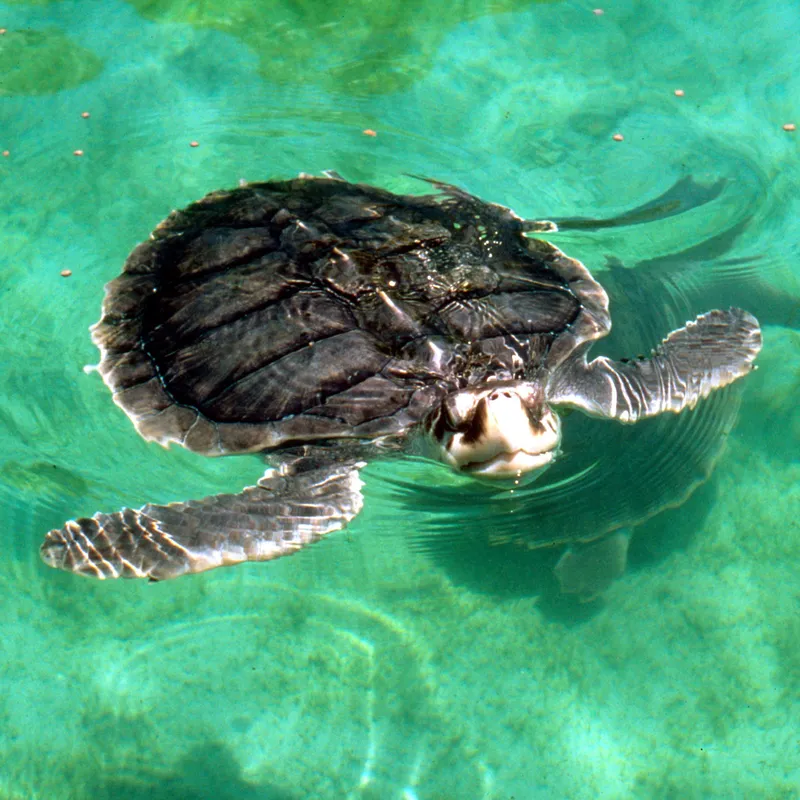
Kemp's ridley turtles are the smallest and most endangered of the world's seven sea turtle species. They have a large triangular head, a powerful parrot-like beak, and an olive-green, round, and flat shell. Their geographical range is among the smallest in the world, as they primarily inhabit the Gulf of Mexico. However, they can also be found in the western Atlantic, as far north as southern New England, and as far south as southern Brazil.
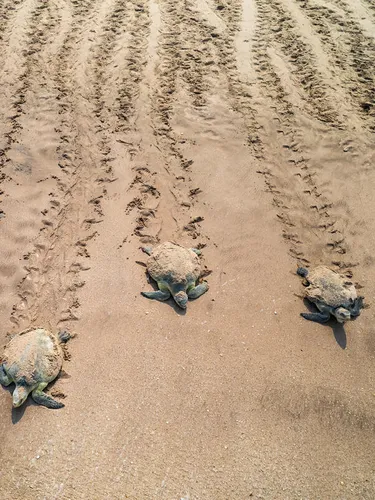
Along with their sister species, the olive ridley, Kemp’s ridley is the only sea turtle species to exhibit synchronized mass nesting. This phenomenon, known as arribada (Spanish for “arrival”), occurs primarily from April to August at intervals of about 28 days. Also, Kemp’s ridley and olive ridley sea turtles are the only turtle species known to commonly nest during the day.
Kemp’s ridley turtle facts
- Status Learn more about endangered status categories and explanation
- Critically endangered
- Scientific name
- Lepidochelys kempii
- Weight
- 70–100 lbs.
- Length
- 24–32 in.
Why Kemp’s ridley sea turtles matter
© Peter C.H. Pritchard / WWF
Kemp’s ridley sea turtles act as an indicator species for marine ecosystems. Their population health reflects the overall quality of the Gulf of Mexico and the western Atlantic. As predators that feed heavily on crabs and other crustaceans, they help maintain balanced nearshore food webs and healthy seagrass habitats. Like other sea turtles, they also support coastal dune vegetation by transferring essential nutrients from rich marine foraging grounds to nutrient-poor nesting beaches. Their recovery represents one of the world's most notable marine conservation success stories, driven by decades of collaboration between Mexico and the United States to protect nesting beaches, reduce fisheries bycatch, and help rebuild the population following its dramatic decline. Despite this progress, the species remains Critically Endangered.
Threats to Kemp’s ridley sea turtles
Although decades of international conservation efforts have helped reverse the species' dramatic decline, many threats persist. Once home to tens of thousands of nesting females at Rancho Nuevo, Mexico, the population crashed to only several hundred nesting females by the mid-1980s. Today, the species' limited range, dependence on a single breeding population, and unique daytime nesting behavior leave it especially vulnerable to threats such as bycatch, harvest of turtles and eggs, habitat degradation, predation, vessel strikes, marine debris, and changing environmental conditions.

© WWF / Urs Woy
Bycatch
A significant threat to sea turtles is their unintended entanglement in fishing gear, which can result in drowning or injury that leads to death or debilitation. This term is commonly known as bycatch. Kemp’s ridleys are primarily caught in trawls, gillnets, longlines, hook and lines, traps, and dredges found in the Gulf of Mexico and the northwest Atlantic.
Turtle and egg harvest
Nearly all of the Kemp’s ridley turtle population nests on the beaches of the western Gulf, primarily in Tamaulipas, Mexico, just south of the United States-Mexico border. Because of their unique arribada nesting behavior, females and nests are concentrated at the same time and place, making nests highly vulnerable to poaching. Decades of sustained conservation efforts have greatly reduced this threat, although continued vigilance remains essential to prevent further population decline.

© Sea Turtle Inc/Shuterstock.com
Nesting habitat degradation
Kemp’s ridley nesting beaches are increasingly threatened by coastal development and rising sea levels. Coastal development can reduce the availability and quality of suitable nesting habitat by converting natural beaches and modifying coastal environments through activities such as shoreline armoring and beachfront lighting. Shoreline armoring, including seawalls, can narrow or eliminate the dry sandy beaches needed for successful nesting. Artificial lighting on or near nesting beaches can deter females from nesting and can also disorient hatchlings trying to reach the sea after emerging from the nest.
Kemp’s ridley turtles and nesting habitats are also threatened by beach driving and recreational beach use. Nesting turtles are difficult to see and cannot move quickly on land to avoid incoming vehicles. Beach driving also degrades suitable nesting habitat by causing sand compaction and creating hollows and mounds, which pose obstacles for nesting turtles and hatchlings attempting to reach the ocean. These obstacles also increase travel time from the nest to the sea, increase exhaustion, and heighten the risk of entrapment. Beach furniture, recreational equipment, and other items left behind by beachgoers can further obstruct nesting females and hatchlings, increasing travel time to the sea, exhaustion, and the risk of entrapment or predation.
Egg and hatchling predation
Along with humans, non-native and native predators, such as feral pigs, coyotes, raccoons, birds, and crabs, prey on eggs and hatchlings for consumption. To promote on-site hatching success, predation control is an effective tool to reduce egg and hatchling consumption.
Vessel strikes
Watercraft can strike sea turtles near ports, waterways, and developed coastlines when they are close to the surface, resulting in injury or death. Sea turtle reproductive migration and onshore nesting season make adult sea turtles, particularly nesting females, even more susceptible to vessel strikes due to the overlap with high-boat-traffic areas.
Marine debris
The increase in pollution in nearshore and offshore marine habitats poses a threat to all sea turtles and their habitats. The Deepwater Horizon oil spill, the largest offshore oil spill in U.S. history, significantly affected nesting, small juveniles, large juveniles, and adult sea turtles along the Gulf of Mexico. Marine debris ingestion is another significant threat to all sea turtle species. Debris such as fishing lines, balloons, plastic bags, plastic fragments, floating tar or oil, and human-discarded materials are often mistaken for food. Discarded fishing gear can also cause entanglement, which can lead to injury or even death.

© suparna hazra/Shutterstock.com
Changing environmental conditions
A variety of changing environmental conditions can significantly affect all sea turtle species. High sand temperatures may reduce hatchling success and alter sex ratios through temperature-dependent sex determination, affecting future population dynamics. More frequent and intense storms can erode nesting beaches and flood nests. Changes in ocean temperatures can also alter habitat suitability and shift the distribution of prey, affecting Kemp's ridley migration, foraging, and nesting patterns.
Cold-stunning
Juvenile Kemp’s ridley sea turtles that forage along the northeastern coast of the United States can become cold-stunned when water temperatures drop rapidly during late fall and winter. As their body temperature falls, they become lethargic, stop swimming and feeding, and often wash ashore stranded or dead. Each winter, aquariums and rehabilitation centers rescue hundreds—and in some years thousands—of cold-stunned sea turtles, many of them Kemp’s ridleys. Although many are rehabilitated and released, cold-stunning remains a significant threat to the species.
How WWF is taking action to protect Kemp’s ridley sea turtles

© JB Manning / Shutterstock.com
Eliminating bycatch
WWF aims to reduce sea turtle bycatch—the accidental capture of non-targeted species in fishing gear—by working with fisheries to switch to more turtle-friendly “circle” hooks and use turtle excluder devices in nets. We also use satellite technology to track turtle movements, helping identify areas where turtles and fisheries may overlap and reducing the risk of future interactions. WWF works directly with fishers to safely release turtles caught in fishing gear.
Protecting sea turtle habitat
Because of the Kemp’s ridley's limited geographic range, protecting its habitats is crucial to its survival. WWF works worldwide to establish marine protected areas (MPAs), expand Important Marine Turtle Areas (IMTAs), and promote responsible coastal development practices to ensure sea turtles have safe places to nest, feed, and migrate freely. We encourage governments to strengthen legislation and provide funding for sea turtle protection. WWF also supports monitoring and patrolling turtle nests in many parts of the world and equipping local turtle conservationists, which often leads to ecotourism opportunities and offers alternative livelihoods.
Satellite tracking
Satellite telemetry allows researchers to track sea turtles as they swim from place to place. These satellite tags do not harm the turtles in any way and are designed to eventually fall off. The data will tell us where important feeding areas are, help us understand migration patterns, and anticipate where turtles may encounter fisheries and their gear.
Addressing the wildlife trade
WWF works with partners and coastal communities to reduce the illegal harvest of sea turtles and their eggs, strengthen protections at nesting beaches, and support local conservation efforts. For Kemp’s ridley sea turtles, this work is especially important because nearly all nesting occurs in the western Gulf of Mexico, where females and nests can be concentrated in the same place during arribadas. Kemp’s ridleys have historically been poached for their meat and eggs, and illegal trade in turtle products remains a broader threat to sea turtles both on the ground and online. To combat this, WWF works with TRAFFIC to disrupt illegal wildlife trade through initiatives such as the Cyber Spotter Program, which helps identify and remove online listings for illegal wildlife products, including turtle products. WWF also supports efforts to train and equip local rangers to deter poaching, protect nesting beaches, and safeguard turtles and their nests during the nesting season.

© JB Manning/Shutterstock.com
How you can help
© George Walsh
Strengthen the Endangered Species Act
More than 99% of the species listed under the Endangered Species Act have avoided extinction due to the law’s protections. Today, those protections are under threat — at the exact moment wildlife needs them most.