
We made nature's decline self-reinforcing. We can do the same for its recovery.

By

© Tom Vierus / WWF-Pacific
The newly released 2026 Living Planet Report from World Wildlife Fund (WWF) documents a 73% average decline in monitored wildlife populations—the latest stark measure of a natural world under extraordinary pressure. Coral reefs are bleaching, forests are shrinking, and some species and ecosystems are barreling toward dangerous “tipping points,” beyond which losses can become increasingly difficult to reverse.
But that is only half the story. Tipping points can work in the other direction too. If we recognize where technology, markets, economic incentives and human choices are beginning to reinforce one another—and concentrate our efforts there—we can accelerate changes that benefit both people and nature.
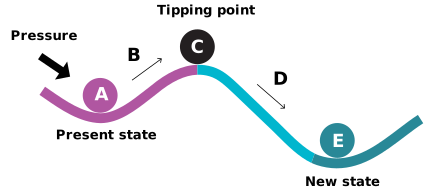
In nature, a negative tipping point occurs when pressures build until a system crosses a threshold and begins moving rapidly toward a new state. Ocean warming, for example, is pushing corals past thermal thresholds where bleaching, mortality and declining resilience feed on one another, threatening the survival of entire reefs.
Human systems can also develop positive feedback loops. A new technology may start out expensive or difficult to access. As adoption grows, production can scale up, costs can fall, supply chains can expand and businesses can gain experience. Each shift lowers another barrier for the next customer, until adoption builds its own momentum.
Pakistan’s extraordinary solar boom illustrates how quickly that can happen. For years, the country struggled with high electricity prices and an unreliable grid. Then the economics shifted. Grid tariffs rose 155% over three years, while global solar panel prices fell sharply. Pakistan also exempted solar imports from duties and sales taxes, making rooftop solar increasingly attractive to households and businesses.

© WWF-Pakistan
Consumers responded at remarkable speed. In 2024 alone, Pakistan imported 17 gigawatts of solar photovoltaic panels—equivalent to more than 40% of the roughly 40 gigawatts of generating capacity in Pakistan’s entire power system. By fiscal year 2025, more than 7.3 million households had adopted solar systems.
This was largely a consumer-led transition rather than a top-down government campaign. Households, farmers and businesses were responding to a basic economic need: power that was cheaper and, in many cases, more reliable than the grid. Government policy helped clear the way through favorable tax treatment and rules allowing some rooftop-solar customers to offset electricity bills by sending excess power back to the grid.
As adoption spread, barriers fell. Local entrepreneurs extended solar supply chains deeper into the country, technicians learned installation and maintenance on the job, and neighbors cutting their electricity bills made solar look more attractive and less risky to the next customer.
Pakistan is a dramatic case, but globally the renewable-energy transition has followed the same basic logic on a longer timetable. Falling technology costs, supportive policies, expanding markets, infrastructure, finance and investment in supply chains accumulated over decades, gradually making renewable energy cheaper, more familiar and easier to deploy.
This kind of change does not materialize out of thin air. Research on positive tipping points emphasizes the role of human agency. Governments, companies, investors and civil society can lower upfront costs, improve access to finance, build enabling infrastructure, remove barriers and coordinate action.
The same logic applies to food and finance, two other systems that shape much of humanity’s impact on nature but have not yet seen the kind of transition we see in energy.
Farmers may have practices available that reduce pressure on nature, but adoption can stall when those practices cost more upfront, carry more risk, require missing infrastructure or serve markets that offer little reward for changing course. Progress becomes more likely when several barriers are addressed together: infrastructure makes new approaches workable, supply chains support them at scale and markets give producers a reason to change how they operate.
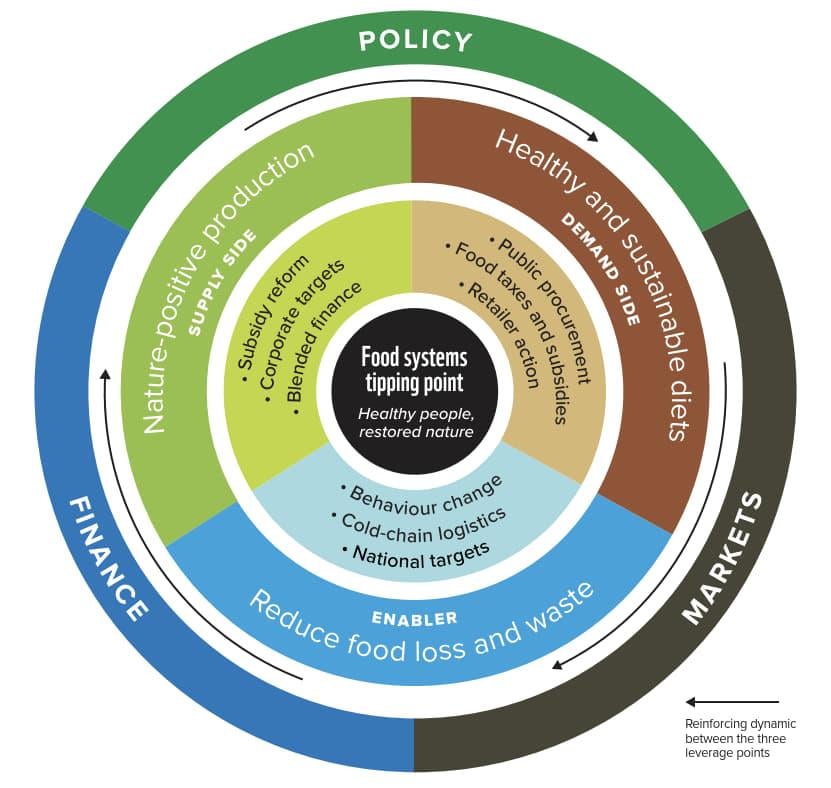
Finance can accelerate similar shifts across sectors. Capital can help farmers overcome the upfront costs and risks of adopting new practices, companies build enabling infrastructure and emerging nature-positive business models reach the scale at which they can compete.
Simply “doing more” is not the answer. We need to identify places where change is becoming possible but remains blocked by a handful of solvable barriers. Is a better technology or practice available but still too expensive? Is demand growing while infrastructure or financing lags? Would coordinated action by companies, investors or policymakers reduce enough uncertainty for others to follow?
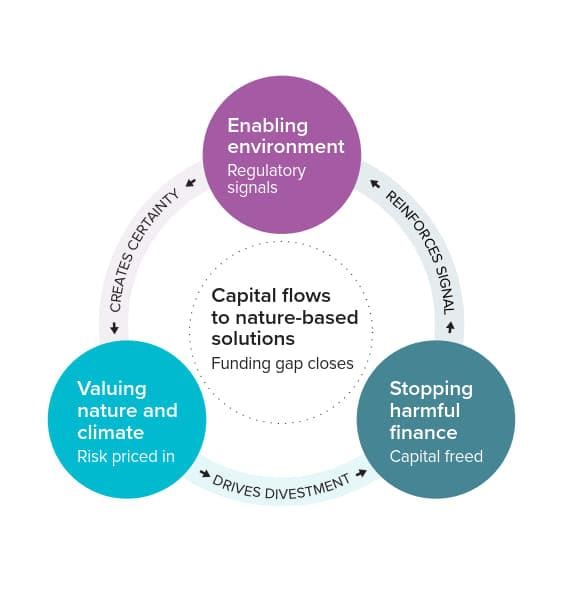
Those are the places where concentrated effort may have an outsized effect. Rather than scattering resources across disconnected interventions, leaders can combine finance, infrastructure, market development, policy and coordination—and stay engaged long enough for those dynamics to take hold.
WWF releases a revised Living Planet Report every two years, and it inevitably arrives with grim news. This year’s report is no exception. But it also points toward a more hopeful question: where are the conditions for positive change beginning to align? Finding those opportunities—and acting with enough focus and persistence to turn them into lasting momentum—is how we bend the trajectory of nature loss toward recovery.