WildinSync
Accelerating the adoption of eDNA as a practical, cost-effective tool for biodiversity monitoring
WildinSync is a global collaborative initiative, led by WWF and ETH Zürich, that brings together governments, academic institutions, conservation organizations, practitioners, Indigenous Peoples and local communities, and private-sector partners to advance biodiversity monitoring through environmental DNA (eDNA) to guide evidence-based conservation, management, and policy decisions.
© WWF-US/Danielle Brigida
The collection of eDNA samples offers a powerful way to understand biodiversity by detecting genetic traces that species leave behind in water, soil, or air. Yet despite its promise, eDNA data are often difficult to analyze, challenging to interpret, and at risk of being lost over time.
WildinSync was established to make biodiversity data more accessible, affordable, and actionable while strengthening local capacity, safeguarding data sovereignty, and supporting long-term data stewardship. At a time when robust environmental information is increasingly needed to inform conservation, sustainable development, and nature-positive decision-making, the initiative generates eDNA-based biodiversity insights and integrates them with satellite remote sensing, environmental variables, and predictive models to provide a more complete ecological picture.
At its heart, WildinSync is a cooperative network. Its mission is to accelerate the adoption of eDNA as a practical, cost-effective tool for biodiversity monitoring by fostering collaboration, knowledge exchange, and mutual support among institutions and countries. The initiative supports local ownership and stewardship of biodiversity data, ensuring that participating institutions retain full control over how their data are managed, used, and shared.
Through this approach, WildinSync helps partners generate the biodiversity information needed to inform conservation planning, protected area management, ecosystem restoration, corporate sustainability reporting, and national biodiversity strategies and action plans.
Curious about eDNA? Learn how this powerful tool is changing the way we monitor and protect biodiversity.
“WildinSync represents a fundamental shift in how we understand and monitor biodiversity. eDNA allows us to see what traditional monitoring often misses. By filling critical biodiversity data gaps, it gives us a more complete picture of nature and a stronger foundation for conservation action.”
Arno Lyet Director, Biodiversity Monitoring
Capacity building & training

© WWF-US/Danielle Brigida
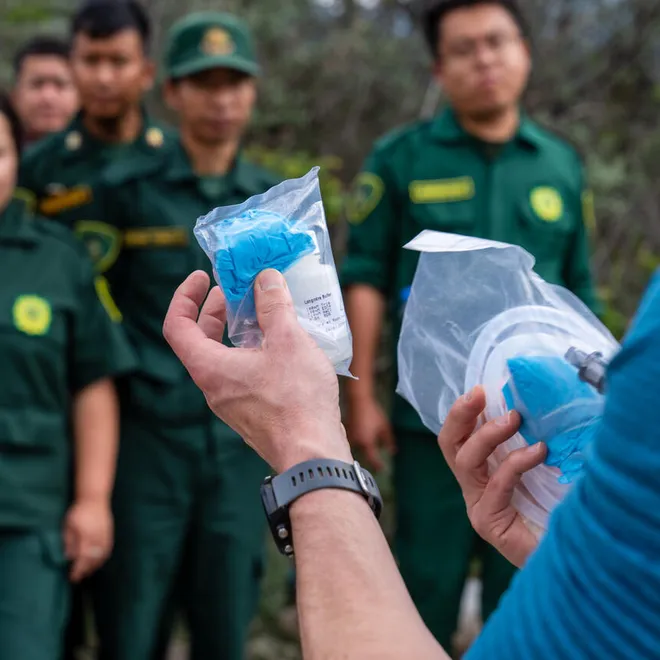
A cornerstone of WildinSync is strengthening local expertise and long-term institutional capacity. The regional or national adoption of eDNA as an efficient scalable method for biodiversity monitoring requires local experts that master the entire technical procedure and who understand the limitation to relay best practice and interpretation to local stakeholders and policy makers.
The initiative provides training and technical support to help partners design eDNA monitoring programs, collect eDNA samples, interpret biodiversity data, and apply findings to decision-making processes and policy implementation. Through hands-on training programs, mentorship, knowledge exchange, and collaboration across scientific institutions, WildinSync helps develop the next generation of biodiversity monitoring practitioners while ensuring that expertise remains within the countries where the data are collected.
WildinSync continuously learns what works best to translate biodiversity data into effective conservation action, helping transform scientific knowledge into evidence-based policy and nature-positive decisions.
Local laboratory infrastructure development

© Bruno Augsburger / Swiss Federal Research Institute
WildinSync supports the establishment and strengthening of local and regional laboratory capacity. For institutions seeking to perform their own molecular analyses, the initiative provides technical guidance and support on laboratory design, equipment selection, quality assurance procedures, and operational workflows.
Partners can access training on DNA extraction, PCR amplification, library preparation, and other laboratory methods required for eDNA analysis. By supporting laboratory infrastructure development, WildinSync helps reduce reliance on external facilities and enables countries to build sustainable, in-country biodiversity monitoring capacity.
WildinSync also supports the establishment of regional biobanks to preserve valuable eDNA samples, creating long-term resources that can be reanalyzed as new technologies and research questions emerge.
Data stewardship & analytical services

© WildinSync
WildinSync provides a suite of analytical support tools designed to address some of the key barriers to eDNA adoption, including bioinformatics, data validation, and biodiversity indicator generation. While collecting environmental samples and generating DNA sequence data has become increasingly accessible, processing, validating, and interpreting those data still requires specialized computational expertise and infrastructure that many organizations lack.
To address this challenge, the WildinSync Platform provides both a secure digital data vault in Switzerland and a free analytics platform that enables users to store, manage, and analyze their biodiversity data.
“The value of biodiversity data isn't in its volume—it's in our ability to turn those data into insights that guide better conservation decisions. By simplifying complex eDNA analyses, WildinSync helps ensure that science can inform decisions where they matter most.”
Abby Hehmeyer
Lead, Biodiversity Monitoring & Conservation Technology
eDNA in action
WildinSync is already delivering tangible conservation impact, demonstrating how eDNA can uncover new insights into biodiversity and support more informed conservation decisions.
-
Detecting endangered species
eDNA confirmed the presence of the woolly flying squirrel in Bhutan—a species once thought extinct for nearly 70 years before its rediscovery in Pakistan in 1994 and documented only once in Bhutan, in 2020—demonstrating the power of eDNA to detect even the rarest and most elusive wildlife.
-
Tracking species recovery
In the Rio Grande, USA, eDNA surveys detected the endangered Rio Grande silvery minnow (Hybognathus amarus), demonstrating the value of eDNA for monitoring species recovery and reintroduction efforts.1
News & stories
Training

© WildinSync
edX Course: Environmental DNA: Sensing the Diversity of Life
WildinSync has developed the first MOOC (massive open online course) on eDNA analysis for biodiversity monitoring and conservation. Learn how to detect, identify and monitor species in a non-invasive way to improve our assessments of diverse ecosystems, so we can find better ways to protect them.

© WILDLABS.NET
WILDLABS Course: Environmental DNA for Terrestrial Vertebrate Conservation
WILDLABS is a global conservation technology community that connects people to share ideas, build skills, and collaborate on solutions that deliver real-world impact. WILDLABS offers an eDNA training course tailored specifically for conservation practitioners.
Experts


© Courtesy of Abby Hehmeyer
Abby Hehmeyer


References
[1] Lindsay, Denise L., et al. "An environmental DNA (eDNA) tool for noninvasive detection of the endangered Rio Grande Silvery Minnow (Hybognathus amarus)." (2025)