Publications
-
The Markets Institute at WWF identifies global issues, trends, and tools around the most pressing challenges of our time related to the production of food and soft commodities. Each year we publish what we think were the biggest surprises of the previous year and release a list of what may be key emerging developments that will affect the global food system and will be important for producers, consumers, the private sector, and governments to consider as they anticipate issues and trends to respond more effectively at speed and scale.
-
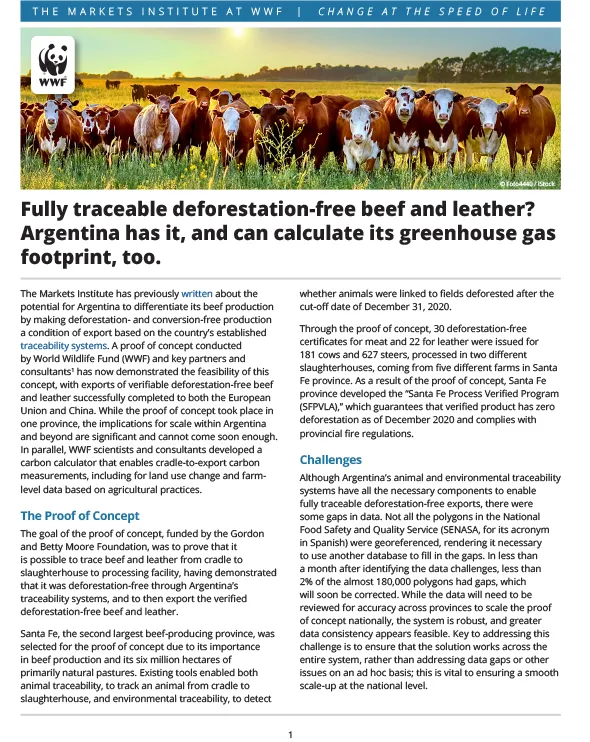
The Markets Institute has previously written about the potential for Argentina to differentiate its beef production by making deforestation- and conversion-free production a condition of export based on the country‚'s established traceability systems. A proof of concept conducted by World Wildlife Fund (WWF) and key partners and consultants has now demonstrated the feasibility of this concept, with exports of verifiable deforestation-free beef and leather successfully completed to both the European Union and China.
-
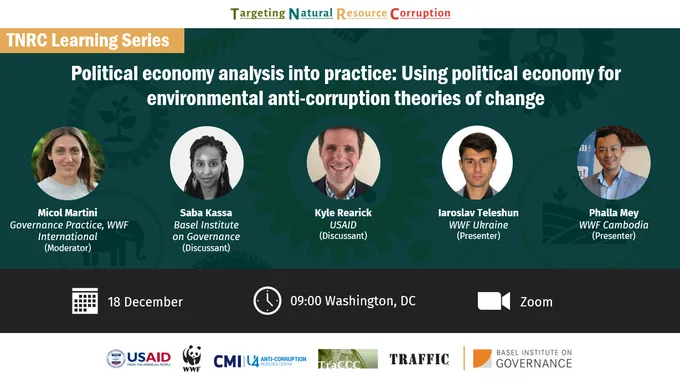
This presentation deck is from a TNRC Learning Series webinar introducing a new guide on Integrating Political Economy Analysis (PEAs) findings into theories of change (ToC) to address corruption that undermines conservation objectives. The webinar was held on 18 December 2023. Panelists discussed the utility of PEAs for designing, testing, or adapting ToCs, identified challenges to using PEA, what conditions have enabled uptake, and offered insights into context-specific PEA approaches and their applications.
---
This content is made possible by the generous support of the American people through the United States Agency for International Development (USAID). The contents are the responsibility of World Wildlife Fund (WWF) and do not necessarily reflect the views of USAID, the United States Government, or individual TNRC consortium members.
-
A knowledge-sharing visit brought together government, private sector, and financial institution representatives from Nepal and India in August 2023 under the Asia‚'s Linear Infrastructure safeGuarding Nature (ALIGN) Project. The weeklong event held in Delhi and Dehradun in India, brought together key stakeholders to identify challenges and limitations in implementing linear infrastructure safeguards; share insights and experiences; problem-solve; and enhance participants‚' understanding of safeguard-related policies and best practices.
-
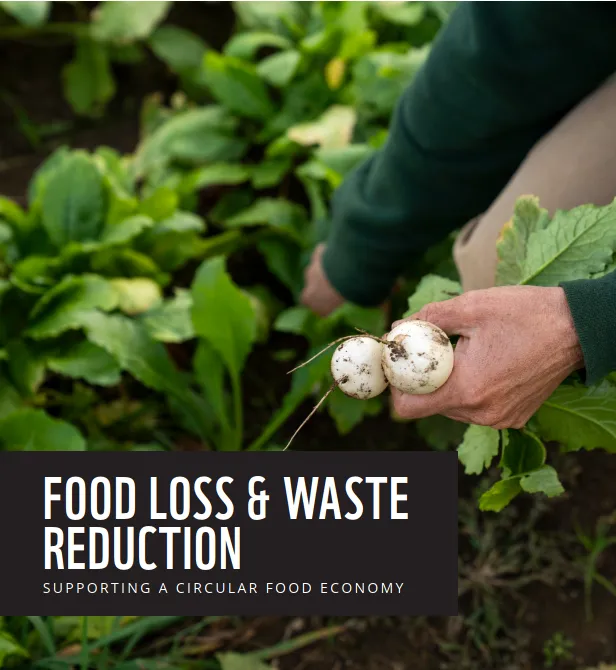
WWF envisions a world where all edible food grown is eaten by people, and remaining nutrients are utilized as feed for animals, while inedible organic matter is returned to the farm to create healthier soils or high-value inputs. WWF aims to harness the power of innovation, collaboration, and responsible stewardship to eliminate food waste at every stage of the supply chain. In this Food Loss and Waste Factsheet, learn how WWF aims to leverage food loss and waste (FLW) as a non-controversial and cost-effective strategy to catalyze a more circular food system, mitigate climate change and nature loss, and help feed those in need.
-
Nepal‚'s expanding linear infrastructure can pose a significant threat to its diverse wildlife and biodiversity by fragmenting habitats and causing other adverse effects, such as depleting natural resources. Nepal‚'s Cabinet of Ministers achieved a significant milestone when it endorsed the Wildlife-friendly Infrastructure Construction Directives on March 10, 2022, followed by the directives‚' official gazetting on April 18. In collaboration with various government ministries and stakeholders, WWF-Nepal‚ – through the ALIGN Project funded by the US Agency for International Development‚ – played a vital role in advocating for the directives and promoting wildlife-friendly practices.
-
-
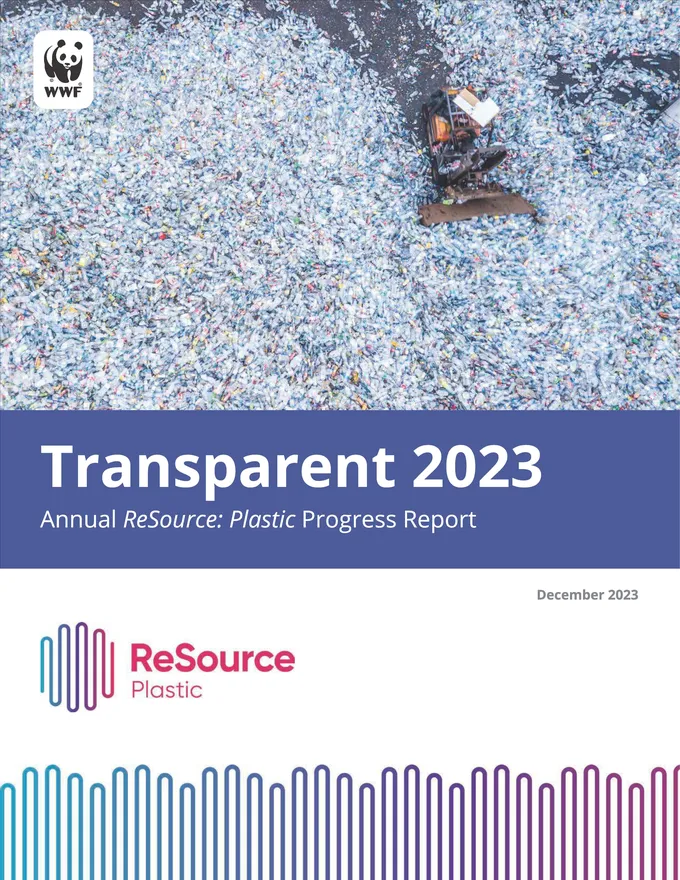
Transparent 2023 is the fourth annual report from ReSource: Plastic, providing an update on how Member companies are addressing plastic pollution and identifying new opportunities to maximize impact.
-
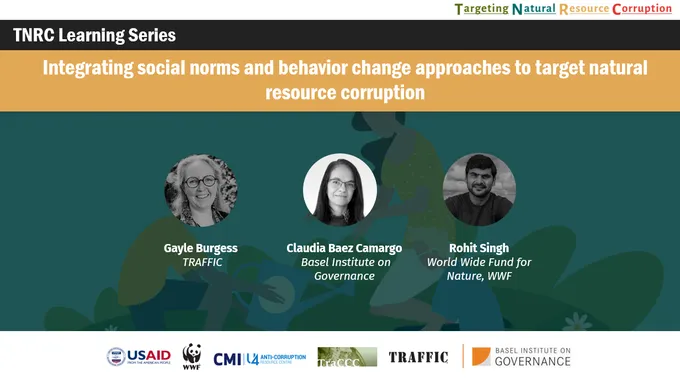
These slides are from a TNRC Learning Series webinar from the Basel Institute on Governance. The webinar shares learning from a series of forthcoming tools and examples for adopting social norm and behavior change (SNBC) approaches to address natural resource corruption.
---
This content is made possible by the generous support of the American people through the United States Agency for International Development (USAID). The contents are the responsibility of World Wildlife Fund (WWF) and do not necessarily reflect the views of USAID, the United States Government, or individual TNRC consortium members.
-
The African Nature-Based Tourism Platform worked with partners in Botswana, Kenya, Malawi, Mozambique, Namibia, Rwanda, South Africa, Tanzania, Uganda, Zambia, and Zimbabwe to conduct surveys assessing the impact of COVID-19 on communities and small to medium enterprises (SMEs) within the nature-based tourism sector. To date, the Platform has conducted 687 surveys across its 11 target countries.
Leveraging this survey data, the Platform has collaborated with partners to develop community-led and designed grant proposals. This collaborative approach has resulted in the mobilization of significant funding going directly to community-based organizations.