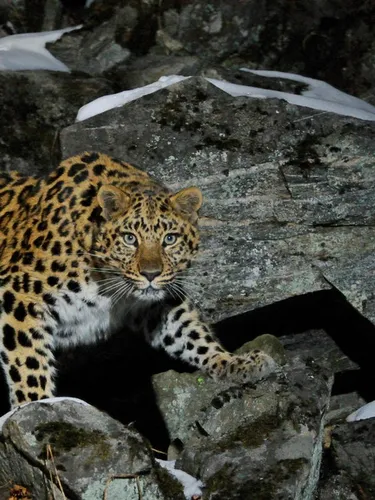
© naturepl.com / Vladimir Medvedev / WWF
Amur leopards
People usually think of leopards in the savannas of Africa, but in the Russian Far East, a rare subspecies has adapted to life in the temperate forests that make up the northernmost part of the species’ range. Similar to other leopards, the Amur leopard can run at speeds of up to 37 miles per hour. This incredible animal has been reported to leap more than 19 feet horizontally and up to 10 feet vertically.
The Amur leopard is solitary. Nimble-footed and strong, it carries and hides unfinished kills so that they are not taken by other predators. It has been reported that some males stay with females after mating, and may even help with rearing the young. Several males sometimes follow and fight over a female. They live for 10–15 years, and in captivity up to 20 years. The Amur leopard is also known as the Far East leopard, the Manchurian leopard, or the Korean leopard.
Amur leopard facts
- Status Learn more about endangered status categories and explanation
- Critically endangered
- Population
- About 130 individuals
- Scientific name
- Panthera pardus orientalis
- Weight
- 70–105 pounds
- Habitats
- Temperate, broadleaf, and mixed forests
Why Amur leopards matter
© WWF-Russia / ISUNR
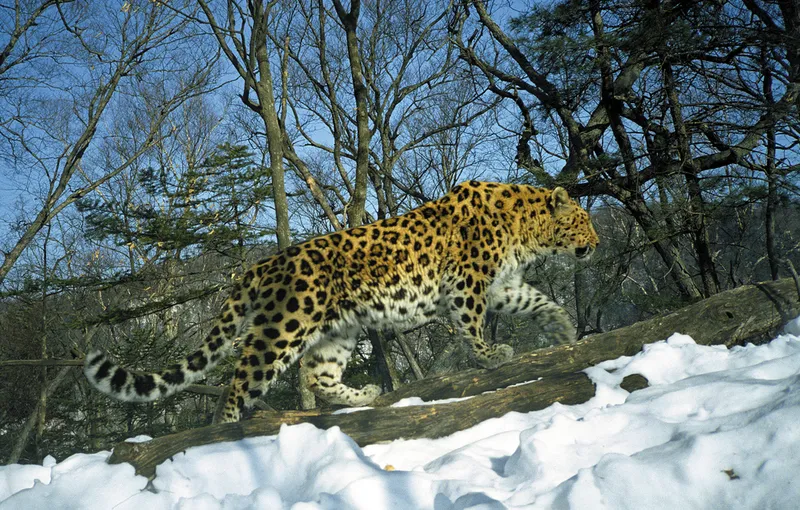
The Amur leopard is important ecologically, economically, and culturally. Conservation of its habitat benefits other species, including Amur tigers and prey species like deer. With the right conservation efforts, we can bring them back and ensure long-term conservation of the region.
Threats to Amur leopards
Prey scarcity
There are still large tracts of suitable habitat left across the Amur in Russia and China. In China, the prey base is insufficient to sustain large populations of leopards and tigers. Prey populations will recover if measures are taken to limit poaching and the forests are managed more sustainably for logging. For the Amur leopard to survive for the long term, it needs to repopulate its former range. But for that to happen, prey populations need to recover first.
Illegal Wildlife Trade
The Amur leopard is poached largely for its beautiful, spotted fur. Agriculture and villages surround the forests where the leopards live. As a result, the forests are relatively accessible, making poaching a problem—not only for the leopards themselves, but also for important prey species, such as roe deer, sika deer, and hare, which are hunted by the villagers both for food and cash.
How WWF is taking action to protect Amur leopards
Stopping poaching and trade
WWF works with governments, conservation organizations, and other partners to combat the illegal wildlife trade and protect leopard populations from poaching and the trafficking of their skins and body parts. By addressing wildlife crime and strengthening efforts to prevent illegal trade and poaching, WWF protects vulnerable species and supports the long-term survival of wildlife.
How you can help
© George Walsh
Strengthen the Endangered Species Act
More than 99% of the species listed under the Endangered Species Act have avoided extinction due to the law’s protections. Today, those protections are under threat — at the exact moment wildlife needs them most.