Living with lions
Helping communities and lions coexist at the edge of the Okavango Delta
By
-
Erin Waite
Photography by
-
Gareth Bentley

© WWF-US/Gareth Bentley
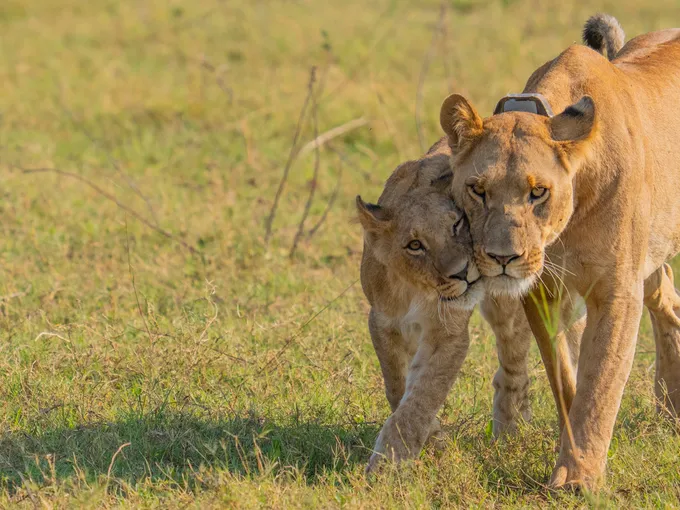
After nightfall one October evening, a tawny 7-year-old lion known as Zamana slips into a papyrus-lined channel in Botswana’s Okavango Delta and heads north. The day’s heat has begun to dissipate as he hauls himself onto an expansive island, a GPS collar visible beneath his dripping mane. In the distance, a cape turtle dove coos its metronomic mantra, the distinctive thrumming that scores daily life in this landscape, one of the largest remaining strongholds for the big cats.
Quietly padding through scattered bushwillows and thorny acacias, Zamana soon emerges onto a meadow where thousands of cattle graze on sparse, parched grasses near herds of elephants, impalas, and zebras. Heads bowed to the sandy veld, the animals seem oblivious to danger. For a hungry lion, it’s an enticing gathering of prey.

© WWF-US/Gareth Bentley
Zamana is one of roughly 900 lions that prowl the Okavango Delta, a sprawling freshwater wetland that fans out within the scorching Kalahari. Around the size of Massachusetts, this improbable oasis sits at the heart of the Kavango Zambezi Transboundary Conservation Area (KAZA), where five countries are working together to protect wildlife while creating conservation-centered economic growth.
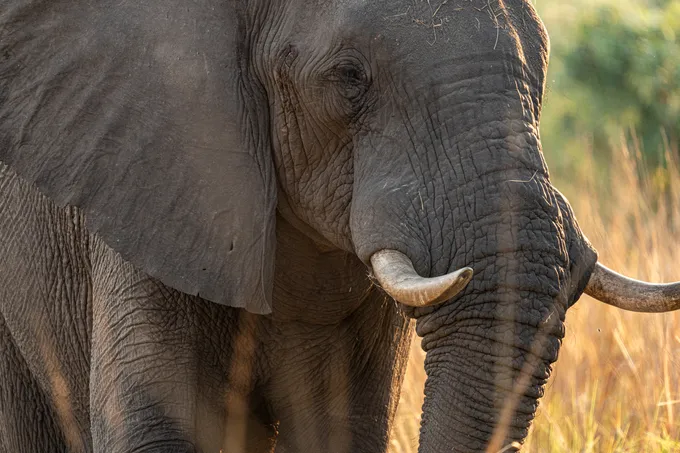
Between July and August, at the peak of Botswana’s dry season, rainwater from Angola’s highlands pours into the delta, transforming it into a mosaic of snaking waterways, verdant marshes, lagoons, and glistening floodplains. Inundated, the ecosystem roars to life. Elephants converge, lured by fresh forage and deep watering holes where hippos wallow as crocodiles bask along the banks. This extraordinary concentration of wildlife has made the Okavango one of the world’s premier wildlife tourism destinations, underpinning an industry valued at $2.5 billion.
But for the more than 10,000 people who live in and around the delta—many of them farmers whose livestock hold significant cultural and economic value—that abundance belies a challenging reality. As increasing human activity fragments habitats and thins wild prey populations, domestic cattle have become easy targets for carnivores, prompting frustrated farmers to retaliate by shooting or poisoning the predators. Poaching has further depleted prey populations, while climate change is fueling longer droughts and erratic rainfall across southern Africa, intensifying competition for resources. As a result, the Okavango has become as much a hotspot of conflict as a haven for biodiversity, with serious implications for conservation.
© WWF-US/Gareth Bentley
© WWF-US/Gareth Bentley
The stakes are especially high for lions. Across Africa, only an estimated 25,000 remain, and the cats have vanished from nearly 95% of their historical range.
“For lion conservation to be successful, we have to find ways for people, wildlife, and livestock to coexist,” says WWF-US carnivore expert Virginia Frediani. “Protected areas are important, but they’re not enough. We also have to manage coexistence in the places between them, where people and lions overlap.”
That means ensuring habitat connectivity so the big cats—whose territories can span up to 100 square miles—can move safely in search of food, water, and mates. It also requires supporting local communities. “People need to see the tangible benefits of living alongside wildlife, like fewer cattle losses, greater food security, and income from tourism or other nature-based activities,” she says. Coexistence is never going to be perfect, Frediani admits, so the goal is durable solutions that offer opportunities for both people and wildlife.
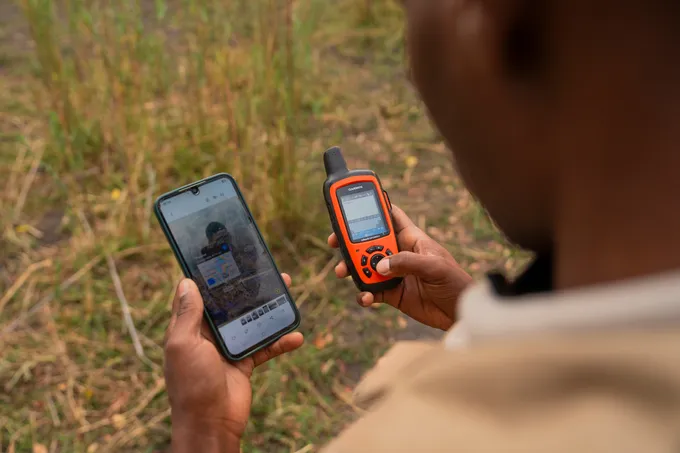
At around 10 that night, Matathata “Pro” Tomeletso wakes with a start as a notification lights up his phone. A collared lion has breached a geofence—a virtual perimeter used to protect cattle—on an island a few miles from the small village where Tomeletso lives with his wife.
He isn’t surprised. “During the dry season, we sometimes receive messages three times a week,” he says. “When water levels drop, lions can cross the channels more easily.” Lately, Zamana has been making his presence known.
70K+ lion alerts have been sent to 400 livestock owners since 2019
helping to cut incidences of human-lion conflict by 50%.
Tomeletso is a conflict mitigation officer at Communities Living Among Wildlife Sustainably, or CLAWS Conservancy, a WWF partner that’s working to help people and carnivores live together more harmoniously. As part of a three-person unit trained to prevent human-wildlife conflict, Tomeletso has handled countless alerts like these. Within minutes, he’s behind the wheel of his Land Cruiser, collecting colleague Joseph Mayoki before charging toward the coordinates where Zamana’s GPS collar last transmitted.
Over the past 12 years, CLAWS has outfitted more than 40 lions across the region with GPS-satellite collars, enabling researchers to keep tabs on the cats’ whereabouts in real time. (Learn more about how WWF and partners coordinate carnivore monitoring efforts across the region.) The devices are linked to a network of geofences; when a lion crosses one, an SMS or voicemail alerts nearby residents—giving them time to herd their cattle into livestock enclosures, or kraals, light fires to frighten off the cat, and warn neighbors—and allowing conflict responders like Tomeletso to step in.
© WWF-US/Gareth Bentley
© WWF-US/Gareth Bentley
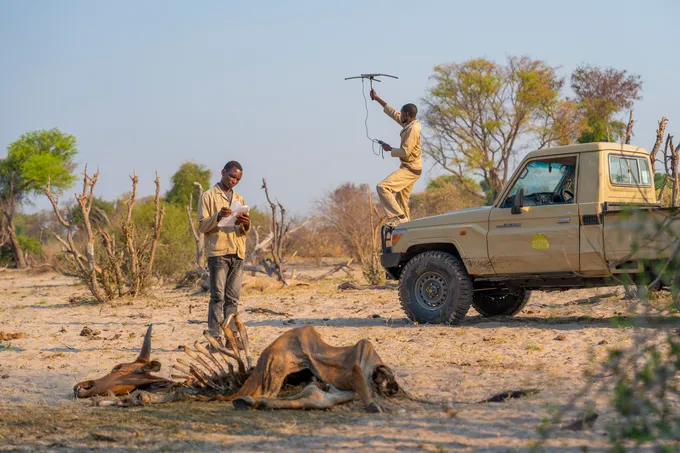
“Anytime we get a message, we try to reach the lion to scare it away with firecrackers before predation can happen,” says Tomeletso. As they approach the site, Mayoki raises a radio telemetry antenna overhead, scanning the darkness for the ping of Zamana’s collar. But the signal is weak. The lion has moved into floodplains too waterlogged for them to follow.
What they do find is a familiar sight: a dead cow in a wide pasture—legs splayed, belly chewed away. Tomeletso crouches to inspect the carcass, confirms the culprit, then calls the owner with the news so she can relocate the rest of her herd to safety and file a claim with the Botswana Department of Wildlife and National Parks, which compensates farmers for livestock lost to carnivores. The payments help alleviate the financial burden of wildlife conservation on local people and reduce the likelihood of retaliation, Tomeletso says.
Since 2024, Zamana’s collar has triggered 3,685 alerts sent to 134 local people.

© WWF-US/Gareth Bentley
Communities here have good reason to fear and resent carnivores. Cows outnumber people in Botswana, where livestock have formed the bedrock of rural life for centuries—supplying milk and meat, and signaling wealth and social standing. Many families treat herds like savings accounts or investments; the average household keeps 16 to 20 head, and losing even one can represent a meaningful financial blow.
Born and raised in the Okavango, Tomeletso knows how swiftly those losses can crescendo into violence. He recalls a time not so long ago when a lion like Zamana would likely have been killed within days. Often, cattle owners would sprinkle a carcass with agricultural pesticides, an inexpensive, easy-to-procure poison. Any animal that fed on it, guilty or not, would pay the price.
Following a string of livestock attacks in 2013, tensions boiled over and farmers poisoned half the region’s lion population in a single sweep, eradicating entire prides and wiping out scores of scavenging hyenas, jackals, and vultures. “The collateral damage was enormous,” says Andrew Stein, the founder and executive director of CLAWS. “Poison is ecologically devastating because it’s indiscriminate. It doesn’t just target one animal; it causes a cascade of impacts on the ecosystem and food chains.”
A wildlife biologist who has spent over two decades researching large carnivores, Stein was struck by the scale and gravity of the crisis, as well as the lack of attention it received. He realized he might be well positioned to help, and by 2014 had recruited Tomeletso and two others to investigate the root causes of the growing conflict. For months, the group traveled from village to village, interviewing farmers to understand why the clashes had intensified. The reason was simple, Stein says: “People were desperate.”
And while communities receive some dividends from tourism and conservation trusts, those payments rarely offset the costs of living alongside wildlife. Government compensation programs also often fail to cover farmers’ losses. If coexistence was going to work, people needed practical, affordable ways to protect their herds, and reasons to see wildlife as assets rather than liabilities. So CLAWS developed what Stein calls a “compassionate, two-pronged approach.”
What’s in a name?
Wildlife researchers typically avoid naming the animals they study, wary of anthropomorphizing them. But for Communities Living Among Wildlife Sustainably, or CLAWS Conservancy, that’s precisely the point.
“A tourist might see lions as majestic creatures,” says Andrew Stein, the organization’s founder and executive director. “But a farmer might say, ‘They’re eating my savings,’ and see them as threats to be eradicated.” To build greater tolerance, CLAWS invites local communities to name the collared big cats in their own language. “The idea is to individualize the lions and foster a sense of connection to them,” says Stein.
The names are telling—revealing fear, anger, or respect, for instance—and, in combination with data that shows how individual lions behave and move across the landscape, they are bellwethers of where conflict might soon flare up and where community outreach, education, or stronger interventions are most needed.
LION NAMES AND TRANSLATIONS
- Zamana “The one who finishes cattle”
- Twashwena “We disagree”
- Mborakure ”The one who kills”
- Mwakahukopo “Don’t do that again”
- Shedipathira “The one who belongs to us”
- Shimono Tiana “No mercy”
- Tharatse “We’re tired”
- Mayenga “One who is decorated by the gods”
“We wanted to find a balance so local people could not only coexist with lions, but benefit from—and even thrive alongside—these iconic animals,” says Stein. First, the organization launched its alert system. Since becoming fully automated in 2019, it has issued more than 70,000 warnings to the conflict mitigation team and to 400 livestock owners, helping to slash losses to predators by half.
CLAWS’ second intervention is more analog: a communal herding program designed to tackle the primary drivers of conflict by reviving traditional livestock management techniques.
On a sweltering morning outside Eretsha, a settlement of mud-and-thatch dwellings amid tall mopane trees, around 150 cattle jostle inside a ringed enclosure, mooing. Six eco-rangers—herders hired from local villages and trained by CLAWS—move with practiced efficiency: surveying the ground for predator tracks, counting cattle, checking for injuries, and inspecting the mobile boma, a temporary cattle enclosure made of sturdy poles and thin shade netting. Soon a gate opens, and the cattle spill out, cowbells clanging and hooves kicking up a thick haze of dirt as the eco-rangers steer the animals toward a grazing site.
“They’ll bring the animals to where the grass is good, usually a different location every day,” says Jack Ramsden, CLAWS’ herding program coordinator, watching the group meander toward the horizon.
For generations, he explains, cattle here were closely tended by boys who shadowed herds from dawn to dusk. But over the past half-century, better access to education and jobs drew new generations to urban centers, shifting socioeconomic structures and shrinking the pastoral labor force. Then in the 1990s, northern Botswana was declared a veterinary “red zone” due to the threat of foot-and-mouth disease, shutting beef farmers out of lucrative export markets. With fewer herders and scant opportunities to monetize their animals, cattle owners progressively let livestock wander unattended.
A drive around the periphery of the Okavango’s northeastern panhandle today reveals cows sauntering along roadsides and grazing alongside zebras and other wildlife. “Sometimes people won’t see their cows for weeks,” Ramsden says, shaking his head. “That’s not good management.”
In CLAWS Conservancy’s project site, the local lion population has grown by as much as 35% since 2019, from around 75 to 100 animals.
Stray cattle are harder to corral and vaccinate—and reliable prey for lions. A 2019 study by Stein and colleagues found that up to 90% of attacks occur when cattle are unguarded. In northern Botswana, farmers have lost dozens, even hundreds, of animals each year. Moreover, the ecological toll is immense. Overgrazing leads to erosion and desertification, degrading vegetation and reducing forage for wild herbivores.
CLAWS’ herding program provides a much-needed alternative by inviting farmers to pool their livestock into larger, collectively supervised herds.
Zamana has breached geofences 31 times in the last two years.
“The eco-rangers stay with them all day and all night,” says Ramsden. Using a model known as Herding 4 Health, the eco-rangers move cattle methodically across the landscape to mimic natural grazing patterns. As the animals feed, their hooves break up compacted ground and their dung fertilizes the soil, allowing native grasses to recover. At night, the herd is secured in predator-proof mobile bomas, where veterinary checks and quarantines keep disease at bay.
Today, 93 farmers from three villages have enrolled more than 700 cattle across four bomas—and conflict has declined sharply. Ramsden estimates that since establishing the bomas in 2019, no more than 10 cows have been lost, and none of the participating farmers have retaliated. Communities are seeing a cascade of other returns, too: lower rates of contagious disease, increased calving rates, and the return of wildlife to restored rangelands, meaning more prey for lions and greater potential for ecotourism.

© WWF-US/Gareth Bentley
These changes have made a welcome difference for Monnaaleso Sanga, a farmer who keeps his cattle in the Eretsha boma. “Before, when cattle weren’t properly enclosed, it was common to lose calves and the losses were high,” he says. “But with better herding practices, things have improved a lot.” Mosadiwatiala Senwametsi, a soft-spoken 22-year-old eco-ranger, has further reasons to see the program’s value: She’s earning steady wages and new skills in a region where economic opportunities for young people are scarce.
“We’re trying to return to the way cattle management was done 70 years ago,” Ramsden says. “I’m hopeful that by saving this traditional way of life, we can save the area, save its lions, and bring back ecological balance.”

© WWF-US/Gareth Bentley
These successes have led to another encouraging development: a growing market for wildlife-friendly meat. Historically, most beef consumed in the delta has been trucked in. To build a regional supply chain for beef sourced from the herding program, CLAWS now partners with global safari operator Wilderness, which owns 20 camps nationwide. The company has pledged to eventually purchase up to 40 cattle per month, at a 10% premium, from farmers who adopt Herding 4 Health practices and agree not to kill lions.
“We have a long way to go,” acknowledges Wilderness environmental impact officer Mpho Williart, citing logistical challenges like treacherous roads that can make cattle transport difficult and costly, as well as limited beef-processing facilities and cold storage.
But in May 2025, CLAWS facilitated the first-ever sale in Africa of Certified Wildlife Friendly beef to Wilderness’ Vumbura Plains lodge. The meat is already being served to staff and will be offered to guests as supply grows. Long term, the ambition is to provision all Wilderness camps—and in time, other tourism operators across the delta—with Wildlife Friendly beef. “We’re not gatekeeping this idea,” says Williart. “We’re trying to share it with other camps willing to get involved.”
If the herding initiative is going to meet rising demand, Ramsden says, it must stand on its own—run by farmers who are financially literate, able to cover the cost of cattle feed and medicine, and managing their herds as consistent sources of income. “My goal is to show that there’s a better way to look after cattle,” he says. “Cattle can provide work. Cattle can be a business. And with this program, people can earn 10 times what they could by letting their animals just wander the floodplains.”
90% of livestock attacks occurred when cattle were unattended versus herded into kraals between 2014 and 2016.

© WWF-US/Gareth Bentley
The following evening, the sunset paints a waterway in splashes of orange and pink as a chorus of crickets greets the night. Standing on the bank, not far from where Zamana dozes atop an abandoned termite mound, Tomeletso and Stein reflect on the changes they’ve observed since CLAWS began working to curb livestock losses and ease tensions between people and Africa’s biggest cat.
Cattle are still attacked, and some lions still get into trouble. But the men have noticed a perceptible shift: Communities that once bristled at the lions’ presence are becoming incrementally more tolerant. “They’ve seen that we really do help,” says Tomeletso. “We help a lot.”
Fewer retaliatory killings means lions like Zamana are living long enough to father more cubs, increasing local lion numbers.
A little more than a decade on, CLAWS’ people-centered approach has yielded remarkable gains. As retaliatory killings have dropped, the local lion population has more than doubled, growing from fewer than 40 animals to just shy of 100.
“There was a real chance these lions weren’t going to make it,” Stein says. “I’d like to think we gave them a second chance.” But what happens next, he knows, will depend less on collars or bomas than on the daily choices locals make about how to live alongside wildlife. “That’s why communities are at the heart of what we do,” he says. “There’s no future for lions without them.”
He’s optimistic. “The Okavango is a reminder that there are still wild, intact places left in the world,” he says. “It represents one of the greatest chances in all of Africa for wildlife conservation.”
In depth
Carnivores in KAZA
More from this issue of World Wildlife

© Juozas Cernius / WWF-UK
Explore more
Keep reading this issue of World Wildlife magazine