Far and wide
Advancing carnivore research, conservation, and collaboration across KAZA
By
-
Erin Waite
Photography by
-
Gareth Bentley

© WWF-US/Gareth Bentley
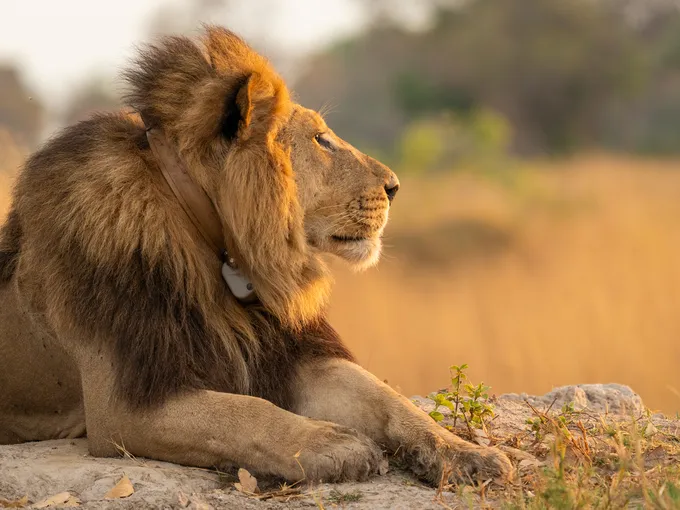
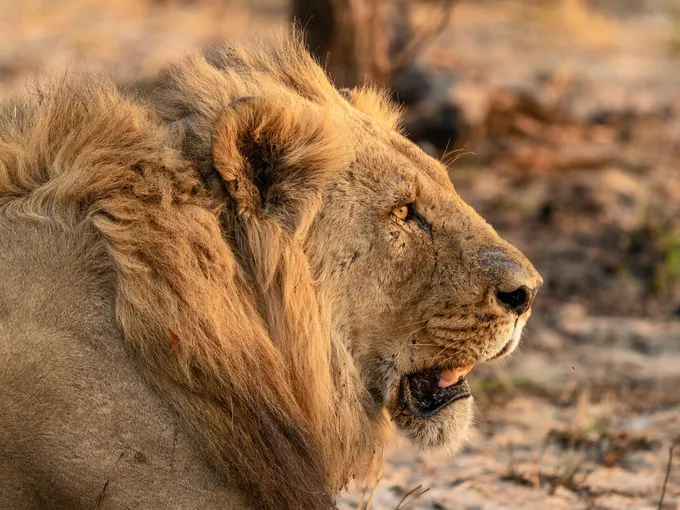
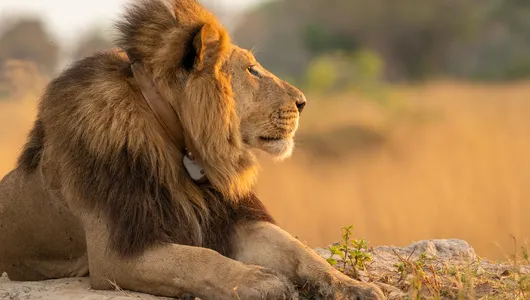
Lise Hanssen guns her 4x4 through dense scrub in Namibia’s Mudumu National Park, a 285-square-mile swath of wilderness that hugs the eastern edge of the Kwando River. Prickly branches scrape the vehicle’s side as she leans out the window, steering with one hand and searching for signs of movement. “There,” she says, braking suddenly and pointing to a lion snoozing about 15 feet away. “This guy and his brother were born here; I collared them after they split from their pride when they were 2 years old.”
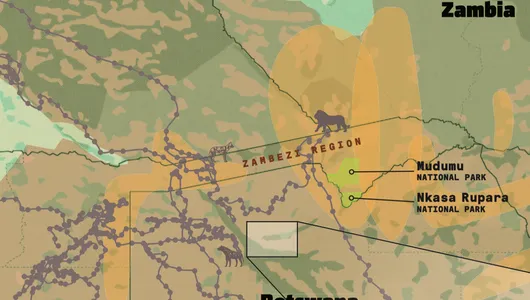
Mudumu National Park lies in the Zambezi Region, a narrow, densely populated strip of land in Namibia’s northeastern corner. Though smaller and quieter than many of Namibia’s better-known protected areas—and home to far fewer lions than the Okavango Delta—this park plays an outsized role in the ecosystem. Together with neighboring Nkasa Rupara National Park, it forms part of the Kwando River Wildlife Dispersal Area, which links populations of lions and other carnivores within the Kavango Zambezi Transfrontier Conservation Area (KAZA).
“These two tiny parks are like stepping stones,” says Hanssen, founder of the Kwando Carnivore Project, examining the lion through beat-up binoculars. “If it wasn’t for them, there’d be almost no connectivity between Botswana and Zambia.”

© WWF-US/Gareth Bentley
Yet over recent decades, villages have expanded, agriculture and livestock grazing have pushed into wildlife habitats, and roads and fences have sliced up key corridors, leaving carnivores to navigate an increasingly crowded landscape. “Mudumu and Nkasa Rupara are surrounded by up to 50,000 cattle and about 25,000 people,” she says. “There’s only so much space.”
Few animals feel the pressure of shrinking, fragmented habitats more acutely than adolescent male lions. Forced from their natal prides at a young age, they spend their early years on the run, skirting areas held by more dominant males until they’re strong enough to claim prides and territories of their own. In the process, they often wind up in proximity to communities—and in conflict with people.
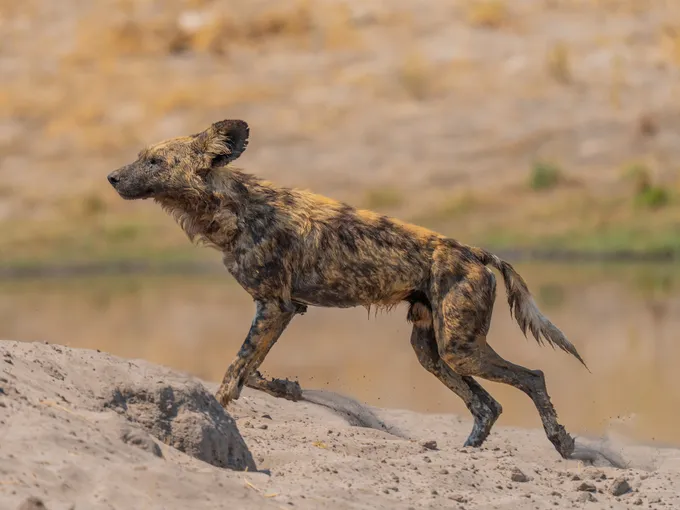
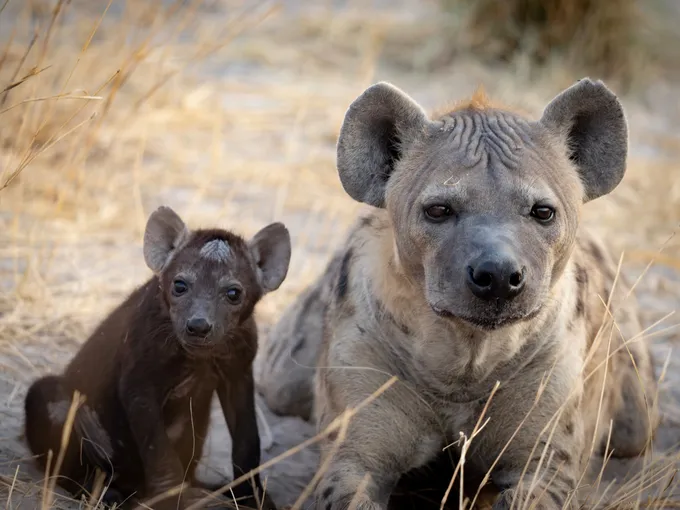
Protecting these animals requires a better understanding of where they’re going and how they get there, says Hanssen. From a modest but well-equipped field camp near Mudumu, she’s spent more than two decades tramping into the bush to collar lions, spotted hyenas, African wild dogs, and cheetahs to track their movements through the Zambezi and beyond. Supported by WWF, her research has illuminated the hidden geography of these species’ dispersals: when they leave protected areas, the routes they follow, and where they run into barriers.
“We’re looking at how they travel through all those human-dominated areas,” she says, “and how we can make coexistence work.”
© WWF-US/Gareth Bentley
© WWF-US/Gareth Bentley
© WWF-US/Gareth Bentley
© WWF-US/Gareth Bentley
In 2024, Hanssen, WWF lead scientist Robin Naidoo, and other collaborators published one of the most comprehensive studies yet of how large carnivores move across KAZA. Analyzing GPS collar data from nearly 200 carnivores—captured over 16 years by NGOs, scientists, and partners from Namibia’s Ministry of Environment, Forestry, and Tourism (MEFT)—they found that half of the 18 longest dispersing animals crossed at least one international border. Three lions and two African wild dogs traversed three countries—Angola, Botswana, and Namibia—while most of the animals remained in KAZA.
Some of those journeys were truly epic: One collared male lion covered more than 500 miles from Namibia’s Khaudum National Park to Botswana’s Central Kalahari Game Reserve. A spotted hyena known as SH2, meanwhile, charted a winding course through Namibia, covering 4,000 miles in nine months—the longest dispersal ever recorded for the species.
“The Zambezi is surrounded on all sides; these animals don’t just stick to one place,” says Hanssen. “From here, they’re connecting to the Okavango Delta, Chobe National Park, Zambia, and Angola.”
Those findings—in tandem with the Kwando Carnivore Project’s ongoing wildlife monitoring work—are now giving direction to landscape-scale conservation efforts. With support from WWF and the Lion Recovery Fund, the organization shares information with conservancies, community leaders, rangers, and villages to influence land-use planning, protect wildlife, and safeguard important corridors and dispersal areas. In some places, that means building greenhouses to improve food security and reduce poaching of prey species carnivores depend on. Elsewhere, it means installing solar-powered pumps that keep watering holes filled to sustain wildlife during droughts or helping communities manage natural resources more sustainably.
“Animals don’t have passports. We have to think the way they do.”
Tanaka Muradzikwa Kwando Carnivore Project operations manager
Hanssen and colleagues also support the Namibian government as it identifies ways to create more resilient ecosystems—drilling new boreholes or restoring habitats, for example—and determines where roads or other development should be steered away from wildlife corridors.
Still, Hanssen says, “the only way to achieve real connectivity for these animals is to get people to tolerate them as they disperse.”
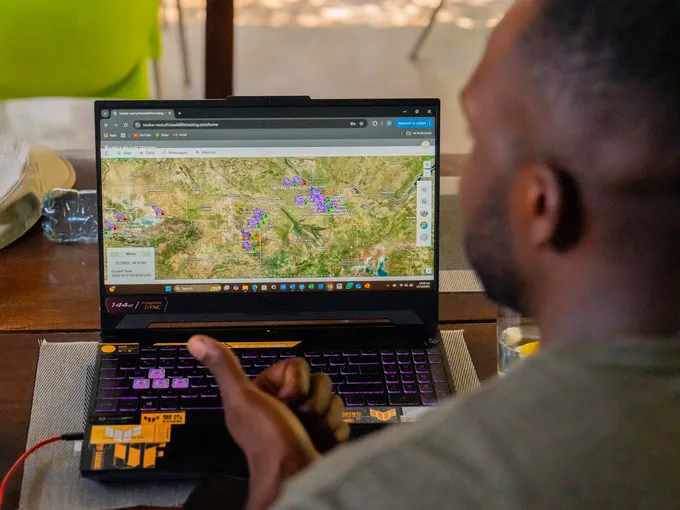
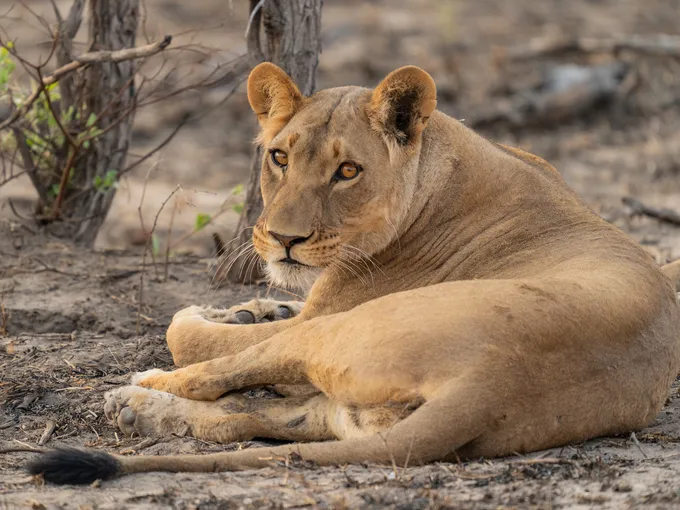
Late one afternoon, in a small village around 15 miles south of Mudumu, Kwando Carnivore Project operations manager Tanaka Muradzikwa balances a laptop on the hood of his truck. On the screen, a map is populated with lion icons, village names, and the zigzagging paths of GPS collars. “This is a pride from Botswana that moved into Namibia—all females and their cubs,” he says, tracing one line with a finger. “They’ve been bounced around by alpha males and have recently started causing problems north of Mudumu.”
For the most part, though, data suggests lions actively avoid people, roving through dense forest along omurambas—ancient, dry riverbeds. “Typically, incidents happen when cattle are left out at night,” says Muradzikwa. He oversees the Kwando Carnivore Project’s monitoring system, and his job is to marry collar data with thorough fieldwork to pinpoint hot spots where local people are losing livestock, and where the organization can intervene before conflict escalates.
To that end, since 2013 the Kwando Carnivore Project has been providing farmers with predator-proof kraals—reinforced livestock enclosures that, unlike weaker structures, keep panicked cattle from breaking through and running into the bush, where they’re vulnerable to attack. Initially focusing on villages near Nkasa Rupara, the program later expanded to Mudumu and farther west, to the Nyae Nyae Conservancy. Upgraded livestock enclosures are proving effective across KAZA as well. “They give farmers a sense of ease at night and greater accountability for their livestock,” says Muradzikwa.
Carnivores don’t recognize political boundaries, he adds, so the Kwando Carnivore Project’s work has to be highly collaborative and take entire landscapes into account. That’s why the organization also partners with neighboring conservation groups—including Communities Living Among Wildlife Sustainably (CLAWS Conservancy), Wildlife Conservation Research Unit (WildCRU), and others—to relay information and alert one another as collared carnivores cross borders or move toward conflict prone areas.
“Animals don’t have passports,” says Muradzikwa. “We have to think the way they do.”
© WWF-US/Gareth Bentley
© WWF-US/Gareth Bentley
All told, the Kwando Carnivore Project has upgraded between 500 and 600 kraals in the Zambezi Region and Nyae Nyae Conservancy. Combined with a geofencing and alert system project funded by MEFT, the approach has helped reduce livestock losses to lions by as much as 90%, even as populations of the big cats have rebounded in the parks. Retaliatory killings have declined too, making it safer for carnivores to move between habitats.
With increased connectivity supporting more abundant wildlife, communities are gaining a deeper stake in coexistence. Lions, for example, are now returning to parts of the Zambezi where they’d once all but vanished, drawing in tourists and revenue. “People go nuts for lions,” Hanssen says, chuckling. “New lodges are being built, and lions and other wildlife are contributing to the economy. It’s exciting.”
For her, that turnaround may be the organization’s most meaningful achievement. “Conservation isn’t just about wildlife,” she says. “It’s about improving social systems and the lives of local people.”
Gordon Homer, who directs WWF’s wildlife program in KAZA, agrees, and says “organizations like the Kwando Carnivore Project and CLAWS Conservancy offer exactly the kind of locally rooted conservation models KAZA needs.” He believes their work can inform and complement WWF’s own efforts.
“Besides securing wildlife corridors, we’ve installed and maintain watering holes inside and outside protected parks to minimize clashes between people and animals,” says Homer. “We’ve also invested in various nature-based projects that shore up livelihoods, and we’re working to expand cluster farms—agricultural initiatives where multiple farmers grow crops on shared plots—that help people earn more from their land without moving into wildlife corridors.”
“When you protect people’s livelihoods, then tolerance follows.”
Lise Hanssen Founder, Kwando Carnivore Project
The overarching goal, he says, is first to safeguard the “micro-corridors” that connect to larger ones, then ultimately the transboundary, landscape-level routes that sustain wildlife and communities across the entire KAZA ecosystem.
“KAZA is an incredible tapestry of people, cultures, and natural resources,” he continues. “WWF’s challenge—and opportunity—is to figure out how all those pieces stitch together—whether that means helping to uplift communities through livestock management and agriculture or developing wildlife economies or forest reserves,” noting that none of it works without the people who live here. “All these approaches have to work in concert across the region, and communities must be part of the solution if KAZA is going to remain a place where people and wildlife can continue to thrive.”
At the end of the day, adds Hanssen, conservationists, communities, and governments all have a shared interest in KAZA’s success. “We want wildlife to recover and flourish, and we want people’s lives to improve too,” she says. “But we can’t do it on our own. It takes a village.”
With gratitude for the generous support of the donors who make this work possible in KAZA—in particular, The Hamer Foundation, The Katherine J. Bishop Fund, and John and Katey Greene for their support of efforts to help large carnivores move safely across the landscape and thrive.
In depth
Carnivores in KAZA
More from this issue of World Wildlife

© Juozas Cernius / WWF-UK
Explore more
Keep reading this issue of World Wildlife magazine