An Indonesian island commits to safeguarding the world’s biggest turtle
By
-
Alison Henry
Photography by
-
Sirachai Shin Arunrugstichai

© WWF-US/Sirachai Arunrugstichai
A nearly full moon illuminates a leatherback turtle lumbering from the sea onto a remote beach on Indonesia’s Buru Island, patterning the sand with ridges and grooves that resemble the tread of an oversized construction vehicle.
When she finally stops to dig a nest with her hind flippers, it becomes clear she has suffered a significant injury: One of those flippers is only a healed stub. Toiling fruitlessly, she pauses at intervals, mouth open and panting. A viscous secretion flows from her eyes.
“Oh, poor girl, what did you get into?” Hengky Tasidjawa murmurs, studying the injury. He speculates that a shark or boat may have caused the damage.
Coaxing the massive turtle away from a rock buried in the sand, he gently guides her toward a better location just to the right. “This is a good place,” he says softly. Then Tasidjawa begins to work in tandem with the turtle’s functional back flipper. He uses the full curve of his arm to drag sand out of the hollow until it’s large enough to contain dozens of eggs.
At one time, Tasidjawa was the most prolific poacher in his village. On nights like these, when up to a dozen leatherbacks emerged from the water to lay eggs, he’d harvest half of each clutch. After collecting between 1,000 and 1,500 eggs, he’d sell them. He poached nesting turtles for a shorter period, too, drying the meat to sell on a neighboring island.
Now he’s a steadfast steward of the very same animals. Since 2016, the father of two has been working as an enumerator for a community-based surveillance group called POKMASWAS. He is trained to monitor and protect this Critically Endangered subpopulation of leatherbacks on Buru Island in eastern Indonesia’s Maluku province.
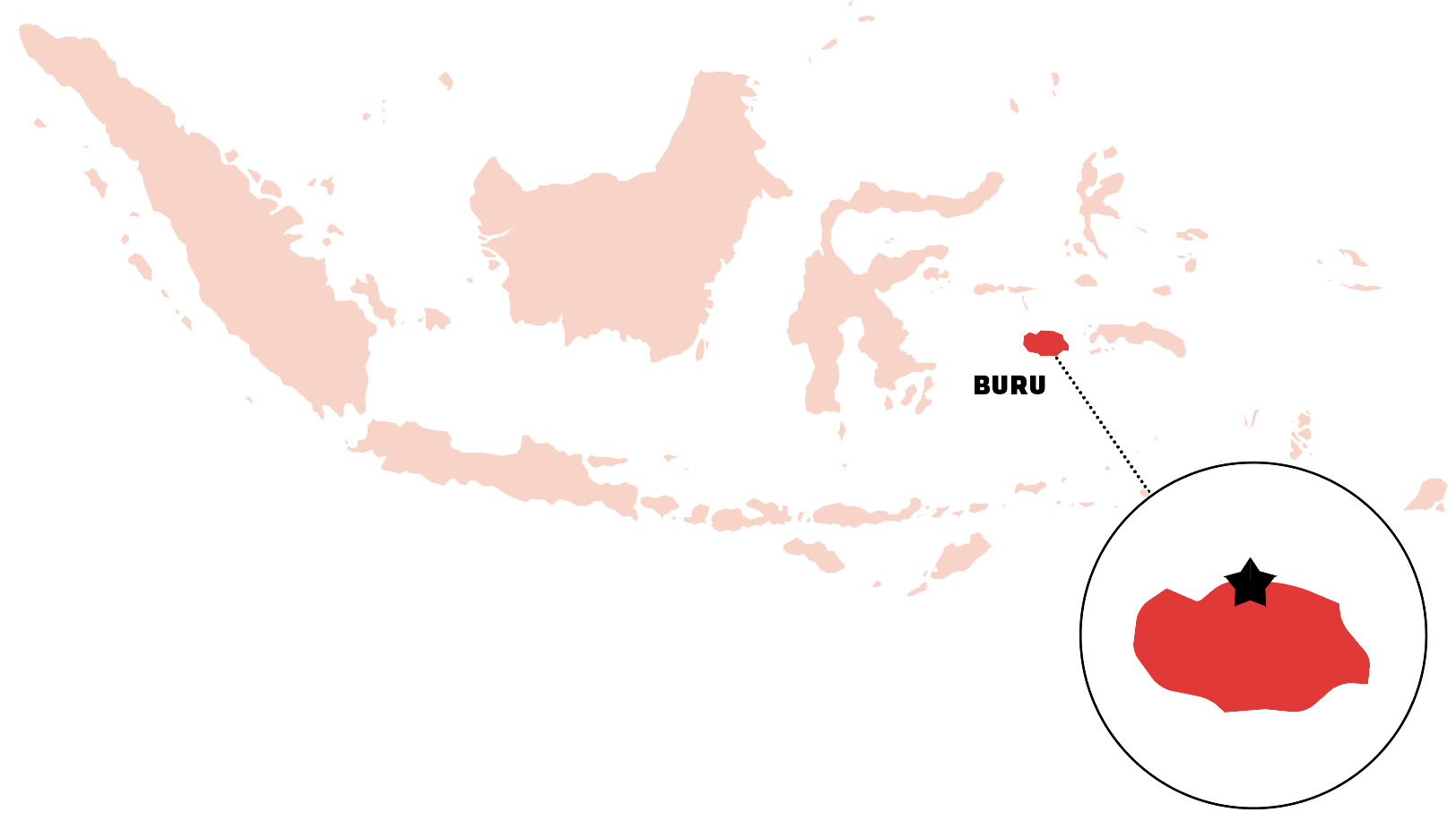
That work is making a big difference. Since WWF and the US National Oceanic and Atmospheric Administration (NOAA) began funding leatherback monitoring here in 2017, local communities have reduced egg poaching from about 60% to virtually zero—a staggering achievement when meaningful progress is typically measured in decades.
What’s more, like Tasidjawa, most locals have no cultural or spiritual ties to leatherbacks. They choose to help protect the species because of their increased awareness of how dangerously imperiled this population is—and how Buru’s nesting beaches can help with their survival.
“Employing former poachers as enumerators has been a big win; they work seven days a week to patrol nesting beaches,” says Mike Osmond, senior program officer for WWF’s Oceans program. “It’s thanks to their commitment to wildlife that we’re now seeing a remarkable reduction in poaching in a relatively short period of time.”
Ancient reptiles

© WWF-US/Sirachai Arunrugstichai
-
6 feet / 1,000 pounds
Length and weight of leatherbacks, the largest of the seven sea turtle species
-
10,000+ annual miles
Some leatherbacks travel incredible distances, assisted by their large flippers and ridge-lined shell
Leatherbacks today look roughly the same as they did when they first appeared on the scene several million years ago. By far the largest of the seven sea turtle species, these living fossils from the late Cretaceous and Paleocene eras measure up to 6 feet in length and can weigh 1,000 pounds. That’s nearly as long as a twin-size mattress with the heft of a golf cart.
Unlike other sea turtles, leatherbacks don’t have hard shells; they have flexible carapaces comprising many small, interlocking dermal bones beneath leathery skin (hence their name). Seven distinct ridges run the length of their backs and taper toward their tails—so evocative of a starfruit that, in Bahasa Indonesia, they’re known as Penyu belimbing, or “starfruit turtles.”
Evolution honed that shape, along with large flippers, for long-haul travel and deep diving. The ridges enhance hydrodynamic performance, enabling some leatherbacks to travel more than 10,000 miles annually. They also dive deeper than any other sea turtle, reaching depths of up to 4,000 feet.
While all seven genetically distinct subpopulations of leatherbacks travel remarkable distances, the Western Pacific population makes the longest journey of all: After nesting on beaches in Indonesia, Papua New Guinea, and the Solomon Islands, many travel nearly 7,000 miles east to feast on jellyfish in rich foraging grounds off the West Coast of the US—a vast migration that takes 10 to 12 months. Others head west in search of food in the Indian Ocean, south toward Australia and New Zealand, or north to stay in the Coral Triangle region.
Threats and solutions

© WWF-US/Sirachai Arunrugstichai
While all leatherback sea turtle populations are at risk, this population has declined by 80% since the 1980s, with bycatch (accidental capture of turtles during fishing) as a major driver as well as decades of illegal egg and meat harvesting—and their numbers continue to decline.
When Western Pacific leatherbacks migrate to and from foraging grounds in US waters, they are at particularly high risk of injuries and drowning from entanglement in commercial longline fisheries, including US fleets off the coast of Hawai’i. The same can happen on a much smaller scale in Indonesia, where local fishers sometimes use gillnets, a long wall of netting that can entangle leatherbacks.
Since Western Pacific leatherbacks spend a notable amount of time in both Indonesia and US waters, both nations share responsibility to protect them. That’s why NOAA works with international partners to change the trajectory of the critically endangered species.
Accordingly, the US formalized leatherback protections with the Endangered Species and Magnuson-Stevens acts. Under these laws, NOAA established regulations for certain fisheries to minimize encounters with leatherbacks, including safe handling and release guidelines and gear changes that minimize bycatch. Some fisheries also have a cap on the number of allowable interactions with the species per calendar year. For example, after 16 such events, Hawai’i-based shallow-set longline fisheries must shutter immediately for the remainder of the calendar year, which creates the potential for economic loss.
Across the Pacific, local fishers disentangling leatherbacks from gillnets can damage or break their gear. WWF and the Marine and Fisheries Department of Maluku Province, where Buru Island is situated, collaborated on a program that replaces broken gear at no cost, encouraging fishers to safely release turtles caught in their nets.
Though NOAA has been working on leatherback conservation at both ends of the Pacific Ocean for 30-plus years, until the last decade, the organization was unaware of a nearly nine-mile-long nesting beach on Buru Island—a site with the potential to boost overall leatherback turtle population numbers and change the odds of the species’ survival.
Hidden in the open
© WWF-US/Sirachai Arunrugstichai
© WWF-US/Sirachai Arunrugstichai
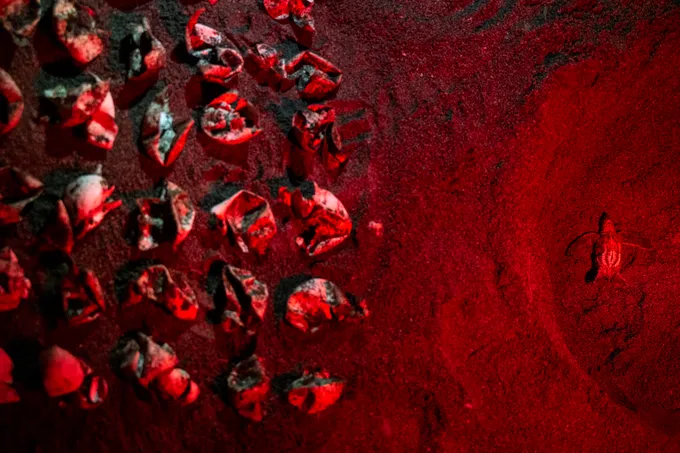
In the mid-2010s, NOAA and the WWF team were conducting rapid bycatch assessment surveys in Maluku Province to gather information on fishing gear, species fishers targeted, and the types of animals accidentally captured. While interviewing fishers in Buru, experts came across a poacher cooking a harvested leatherback turtle and began asking questions. They learned that the island’s sandy shores supported nesting leatherbacks, which was new information for the scientific community. Previously, researchers had only identified nesting beaches for Western Pacific leatherback turtles in West Papua, Indonesia, with smaller nesting sites in Papua New Guinea and the Solomon Islands.
And so, the team pivoted.
By 2017, NOAA and WWF realized this area had once supported large numbers of nesting leatherbacks. But it was also a place where large numbers were harvested. Villagers indicated that in the 1980s and early 1990s, poachers pulled hundreds of female leatherbacks off the beach for their meat and harvested their eggs. Nesting numbers plummeted as a result, rendering the practice economically unviable. Still, low-level poaching of about three to five turtles per season continued, along with harvesting eggs from nests.
In 2017, a new WWF project funded by NOAA, with support from the Indonesian government, aimed to bring that number to zero. To protect nesting leatherbacks and their eggs, the team started working with government officials at all levels—village, provincial, regional, and federal—ensuring a collaborative and locally led approach. The strategy includes community outreach, education, local regulations, and year-round monitoring.
A new direction
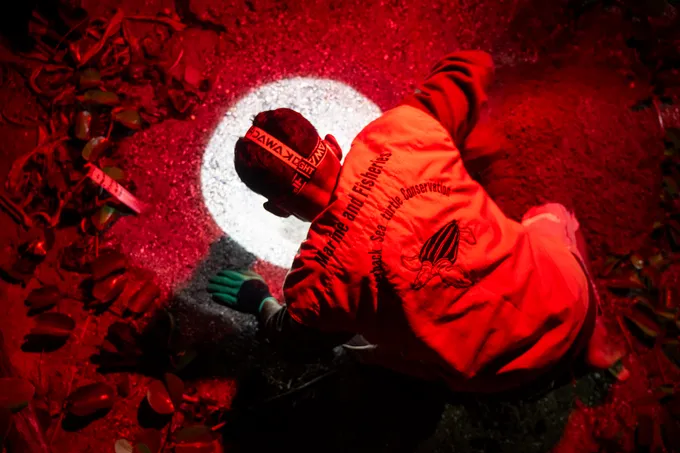
A balmy day melts into night as a dozen men gather in Wamlana, one of four villages along Buru’s nesting beach. Their khaki uniforms feature embroidered leatherbacks, identifying them as enumerators. They’ll soon split into pairs with walkie-talkies to patrol the moonlit shoreline in search of nesting turtles.
When WWF and NOAA established a year-round monitoring program in Buru, they hired poachers like Tasidjawa first, offering them a new source of income.
“Employing people who used to be poachers as enumerators has been a big win,” Osmond says. “They were now able to understand the conservation ethics behind the reduction in poaching, and they have become turtle champions.”
Enumerators collect data that’s crucial for conservation—logging leatherback measurements, scanning for or inserting subdermal tracking tags, and taking identifying photographs. They also mark nest locations with stakes, noting when eggs were laid so they’ll know when they’ll hatch and how many hatchlings emerged.

© WWF-US/Sirachai Arunrugstichai
Outreach and education
The large, yellow community room in Waenibe Village buzzes with excitement as people of all ages fill row after row of wooden benches. School-aged children cluster together, swinging their legs and giggling, ready for an afternoon of activities and information about the animal that has become a source of local pride.
Naufal Dafa Athallah, WWF-Indonesia’s marine biodiversity officer for Buru Island, who lives nearby in Wamlana Village, picks up a microphone and starts the semiannual leatherback conservation event. He peppers his eager audience with questions and hands out prizes for correct answers.
Among the most passionate participants is a 24-year-old teacher who stands to speak to a rapt audience about the importance of leatherback conservation. Debora Natalia Tasidjawa, the daughter of poacher-turned-protector Hengky Tasidjawa, feels a deep connection to leatherback conservation.

© WWF-US/Sirachai Arunrugstichai
Initially unaware of the species’ significance, Debora’s perspective shifted after witnessing the impact of her father’s efforts, and she now weaves leatherback conservation into the lessons she teaches in her secondary class.
“At first the students didn’t understand,” she says. “But now they realize that turtles are important to our lives. As humans, we live side by side with animals in the sea.”
Community outreach like this event is critical to conservation efforts—but local religious, cultural, and village leaders play a leading role year-round.
“In Waenibe, people are enthusiastic about protecting and caring for turtles,” says Meiji Nenete, a church leader who includes conservation messaging in her sermons and points to the Book of Genesis. “God commands us to care for animals—those in the sea and on land.”
Leatherbacks and the law
In 1990, Indonesia passed regulations that protect the six sea turtle species that swim in its waters, along with other marine animals. But the practicality of enforcing federal law across the country is complicated by the fact that Indonesia is an archipelago of more than 17,000 islands spanning a distance wider than the continental United States.
Beginning in 2018, WWF-Indonesia worked with regional and local governments to develop regulations against poaching leatherback eggs and nesting females. The nesting beaches are close to the city of Namlea, a bustling port where the Fisheries Department of Buru Regency sits, vastly improving communication.
“It feels like only from the kitchen to the living room,” says Ufaira bin Thahir, head of the Buru District Fisheries Agency. She’s in frequent contact with village leaders and WWF’s Dafa Athallah—who are all about a 90-minute drive from one another.
This collaboration, along with seeing community members take pride in protecting leatherbacks, contributes to bin Thahir’s sense of fulfillment. It wasn’t so long ago that she traveled to the villages to see a leatherback.
“I knew it from a book first,” she says. “But seeing one for the first time was extraordinary.”
And this dedication and leadership from local leaders like bin Thahir has carried through to the federal level; Buru and the Kei Islands have been included as priority locations in Indonesia’s National Plan of Action for Sea Turtles from 2024 to 2029. Alignment between local and national strategies means local governments have greater access to funding, support, and other resources necessary for implementing conservation effectively.
Building on those efforts, the Indonesian government officially established a 142,000-acre marine protected area in the waters surrounding Buru Island last November. “This conservation area supports the protection of Buru’s leatherback turtles, and we are committed to delivering real protection on the ground,” says Erawan Asikin, the head of Maluku Province’s Ministry of Marine Affairs and Fisheries.
Into the night

© WWF-US/Sirachai Arunrugstichai
Back on the beach, Tasidjawa tenderly brushes the sand from the nesting turtle’s head, his headlamp illuminating the white spots on the leatherback’s dark skin. As she lays her eggs, he readies her black-and-white speckled face for an identification photo.
Panting laboriously, the turtle buries her eggs. Then she trudges around the beach, flinging sand in every direction to disguise the location of her nest—alternating between periods of vigor and rest.
Then, shuffling back to the sea, she slips into the dark water.
“We have to protect the leatherback turtle because we really love this thing,” Tasidjawa says. “My message from Buru Island: Pay attention to this leatherback turtle island so these animals don’t become extinct.”
A future for Kei Islands’ leatherbacks
95% reduction in the number of harvested leatherback turtles since outreach started on Kei Islands

© Jürgen Freund / WWF
Some 350 miles southeast of Buru, the waters surrounding the Kei Islands are replete with jellyfish. Large groups of leatherbacks gather here to feed—a remarkable occurrence given that it’s extremely rare for them to convene en masse near shorelines. But this gathering also leaves them susceptible to hunting.
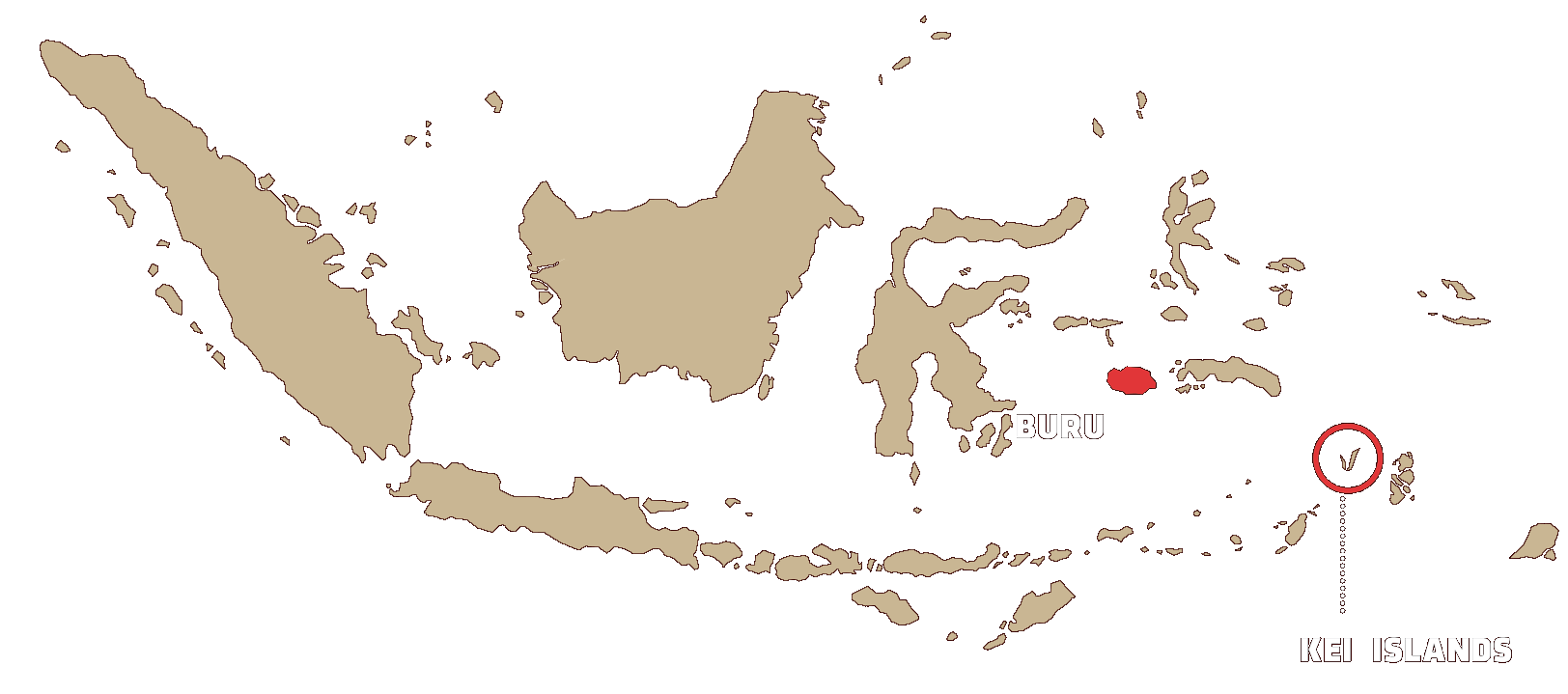
Unlike in Buru, leatherbacks are culturally significant to the people of the Kei Islands. “Some of the villages still consider leatherbacks an important part of their religion, use them for cultural purposes, and when harvested, distribute the meat across the entire community,” says Ranny Yuneni, marine endangered species program manager at WWF-Indonesia. “The practice has deep cultural roots and has been maintained over many generations.”
Over time, a shift toward unsustainable hunting of turtles for trade rather than cultural rituals began worrying local leaders, since it impacts the leatherback population—and an important tradition.
As so few hatchlings reach maturity, every mature egg-laying leatherback is critical to the survival of the species. Stopping the hunting of leatherback juveniles and adults in Kei is crucial to the continued survival of the species.
Since 2017, WWF and NOAA have worked in 11 villages here—mainly through outreach to religious and cultural leaders—to reduce the number of leatherbacks harvested. The work includes identifying and collaborating with key village and religious leaders, ensuring cooperation from district and provincial fisheries agencies, and establishing a monitoring program with staff from villages that participated in the hunt.
Data collected to help track harvest levels shows that the number of leatherbacks taken has decreased by approximately 95% since outreach work began.
© Sara Germain/USFWS
Explore more
Keep reading this issue of World Wildlife magazine