Meet two heroes taking on food waste in the school cafeteria

By

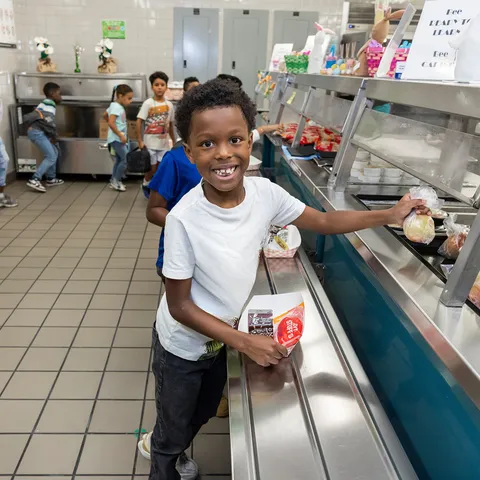
© WWF-US/Rebecca Drobis
When it comes to food loss in schools, we are swimming in waste, or at least we could be, since 45 million gallons of milk—enough to fill almost 70 Olympic-sized swimming pools—are thrown away each year. That’s in addition to 530,000 tons of solid food thrown out by schools on an annual basis. These losses have real consequences for the planet, wasting natural resources and contributing to biodiversity loss.
Tackling waste on a scale like this may seem like a Herculean task, but a new generation of waste-cutting heroes has already stepped up, proving that it can be done.
Teachers are educating students about the impact of food production, empowering them to make sustainable choices; students are organizing compost and food rescue programs; and together they are implementing science-based solutions that have been proven to slash food waste by up to 70%.
Driven by a passion for a greener, healthier planet, this extraordinary group of leaders is showing that small actions can yield big results, that schools have the potential to lead the way on food waste prevention, and that no challenge is too big for those who care.
So who are these heroes? There are hundreds across the country—too many to name here—so we are focusing on the work of two individuals whose work has already touched many lives. They tell their own stories below.
Kareena Gupta
2026 graduate of Poolesville High School in Poolesville, Maryland
As a young person, I am often told that climate change will affect my generation, and it is our responsibility to implement sustainable solutions. With this in mind, my classmates and I acquired a grant from WWF’s Food Waste Warriors program to start Compostology, a composting program in our school that diverts wasted food from the landfill, prevents the release of greenhouse gases, and creates nutrient-rich soil. Over five years, we have expanded this program to 17 other schools within our county.
We’ve also helped Montgomery County Public Schools start another program called Food Recovery. This program allows students to place their unopened, uneaten cafeteria food into a refrigerator or a cart, allowing other students to take this food for free. If there is food left over, it gets donated to local food banks or shelters. This helps keep food out of landfills and redistributes it to the broader community, helping fight food insecurity. There are now 118 schools participating in Food Recovery.
My classmates and I also focus on advocacy at the county and state levels to promote food waste reduction policies. We have collected over 25,000 postcards from students expressing their support for food waste reduction and presented them to legislators on various advocacy nights. These efforts helped pass SB124, a Maryland state bill that allocated $1.25 million in grant funding for K–12 schools to start their own composting and food recovery programs.
All in all, we have successfully diverted over 3 million pounds of wasted food from the landfill and have reached about 60,000 students in our school system.

© Courtesy of Kareena Gupta
Gerin Hennebaul
STEM/STEAM specialist for Lovin Elementary School and Murphy Middle School in Atlanta, Georgia
In fall 2018, my fellow teachers and I noticed how much food was going to waste in our cafeteria. When looking for solutions, we found the Food Waste Warriors program, which helped us get started.
Our initial wasted food audit revealed that we discarded 449 pounds of food in just one day. If that trend continued throughout the school year, we would be throwing away over 81,000 pounds of wasted food during the school year.
Our students then put their heads together to find solutions that could help reduce the waste generated in our cafeteria. They created public service announcements about wasted food for the school announcements; they began saving leftover food from the teachers’ salad bar to feed our chickens, and they introduced a share table. By the start of the 2023–2024 school year, we were collecting discarded food daily from all grades for composting through a new peer-to-peer learning program.
So, what kind of results have we seen? In February 2025, we did another audit. That day, our students threw away 128 pounds of food in the cafeteria. This was a dramatic 70% decrease from when we did our initial wasted food audit. We also conducted an audit on our share table and discovered that we are typically able to re-share about 575 items per week!
The impact of our work is evident in many ways. Many families have begun compost bins at home. Students are eating more of their food and eating healthier. And they are so passionate about how their small changes are making a big impact.

© Courtesy of Gerin Hennebaul
Turn the cafeteria into a classroom
WWF’s Food Waste Warriors program provides K–12 schools with free online toolkits to help them develop safe, fun, creative, and research-backed strategies to reduce and prevent food waste in cafeterias and classrooms.
© WWF-US/Rebecca Drobis